artwork by Gemini 3 Pro
Nova - The AI Co-Designer That Learns Your Taste
Game Architecture
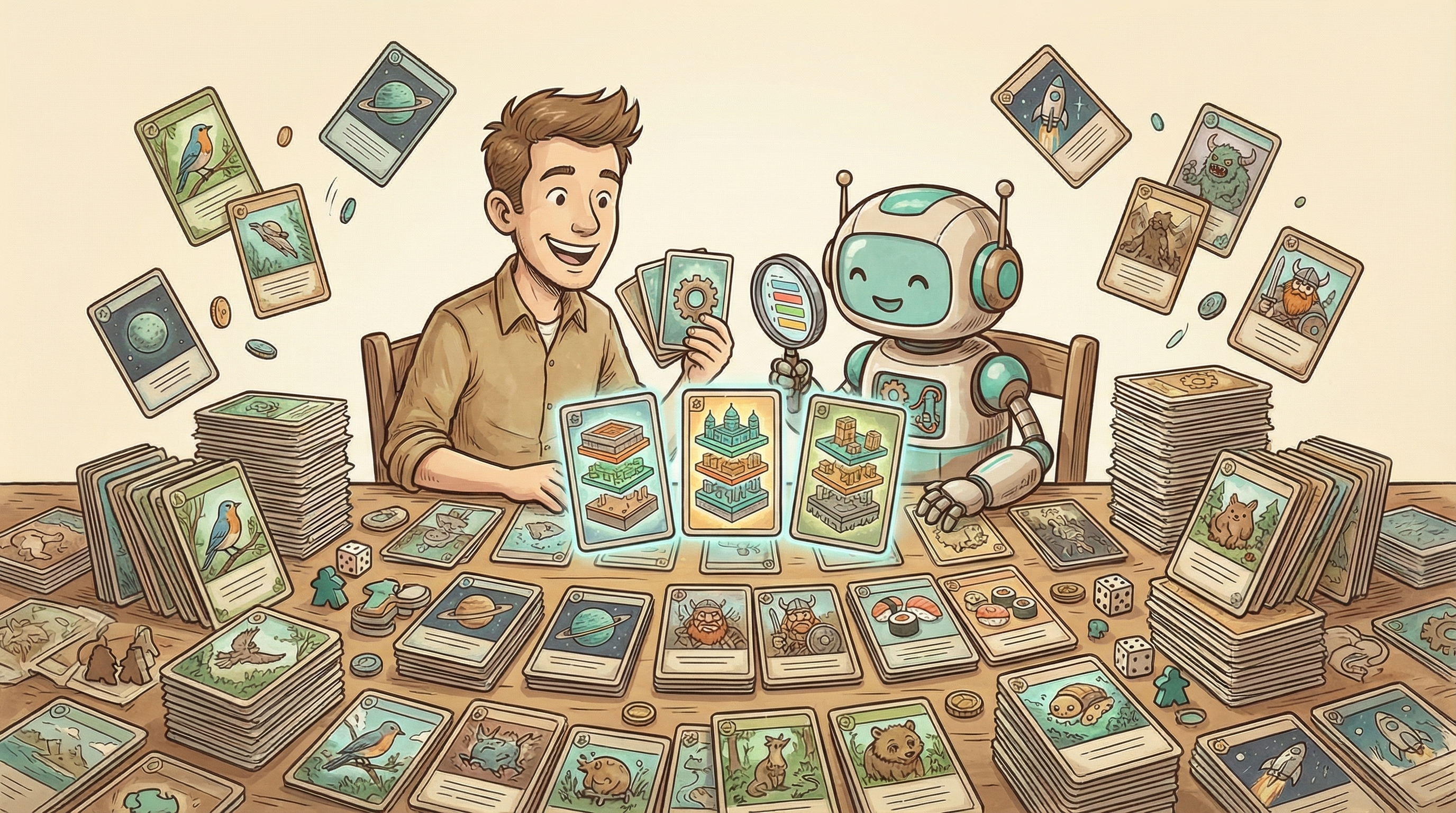
Part 7 of 10In the previous article, we laid out the theory behind GameGrammar: structure enables generation, generation enables iteration, and the designer stays in control. But there was something missing. As the designer pushes buttons and fills out forms, the AI is reduced to a toolbox, rather than a colleague. Our solution is Nova, a conversational AI co-designer that remembers your decisions, learns your taste, explains its reasoning, and gets better at helping you the more you work together. Every design session becomes training data for improved partnership.

Figure. A designer and their co-designer, working together on a board game blueprint. Nova is not a robot. It is a pattern of light, a constellation that accumulates the designer’s intent and helps them flare with creative energy.
Where We Left Off
In The Theory of Generative Board Game Design [2], we established a principle: AI proposes, you decide. How do we close the interaction gap between the two?
When you used GameGrammar’s AI assistance, you clicked buttons. “Fix this inconsistency.” “Rewrite this section.” “Show me suggestions.” Each action was a one-shot transaction. The AI did not remember what you asked last time. It did not know that you had already rejected the auction mechanism because it clashed with your game’s tempo. It did not learn that you consistently prefer indirect competition over direct conflict, or that your complexity sweet spot is somewhere between Azul and Terraforming Mars.
The Morning Standup That Does Not Exist
The idea for Nova came from a GameGrammar [4] user named Donald, an experienced game designer who saw the potential before we did:
“Have you thought about having a running chat with an AI about the game holistically, who would know when to kick something to one of the agents? Similar to a morning discussion about yesterday’s prototype that would be happening in creator studios.”
Donald was describing something specific: the standup meeting that every professional design studio has. From the moment you walk in, your collaborator knows your game and past decisions. They understand your decisions, and do not require any explanation for what “the auction mechanism feels too slow at four players” means. They remember what you tried and why you tried it. Their direction is informed and useful.
That collaborator does not exist for solo designers. It does not exist for small teams working evenings and weekends. The talent and vision are there. The time for a second brain is not.
From Toolbox to Colleague
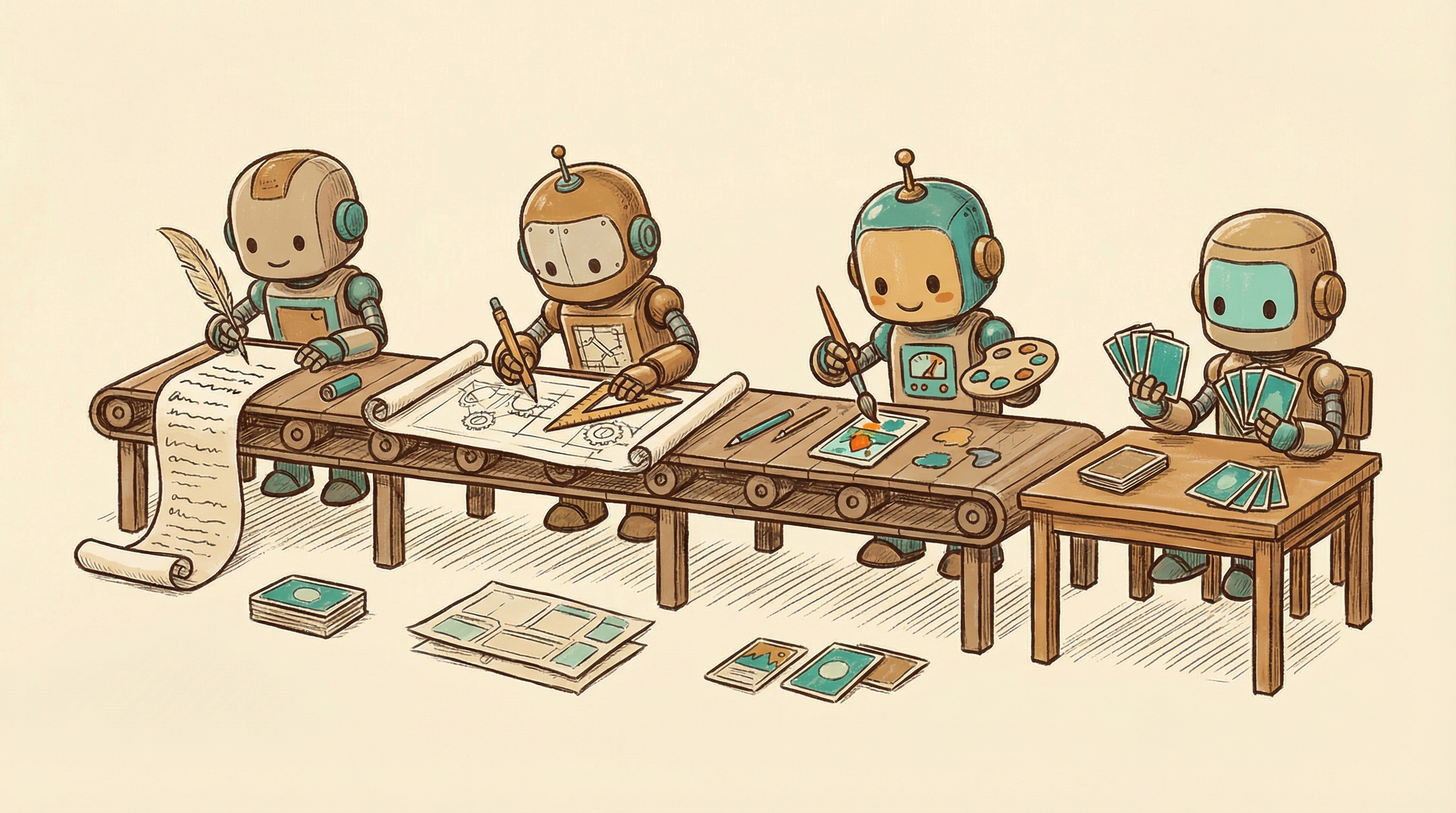
GameGrammar’s previous AI assistance was a toolbox: five modes of help (rewrite, fix, edit, suggest, evaluate), each powerful on its own, each stateless. Nova unifies those five modes into a single conversation where context accumulates instead of resetting.
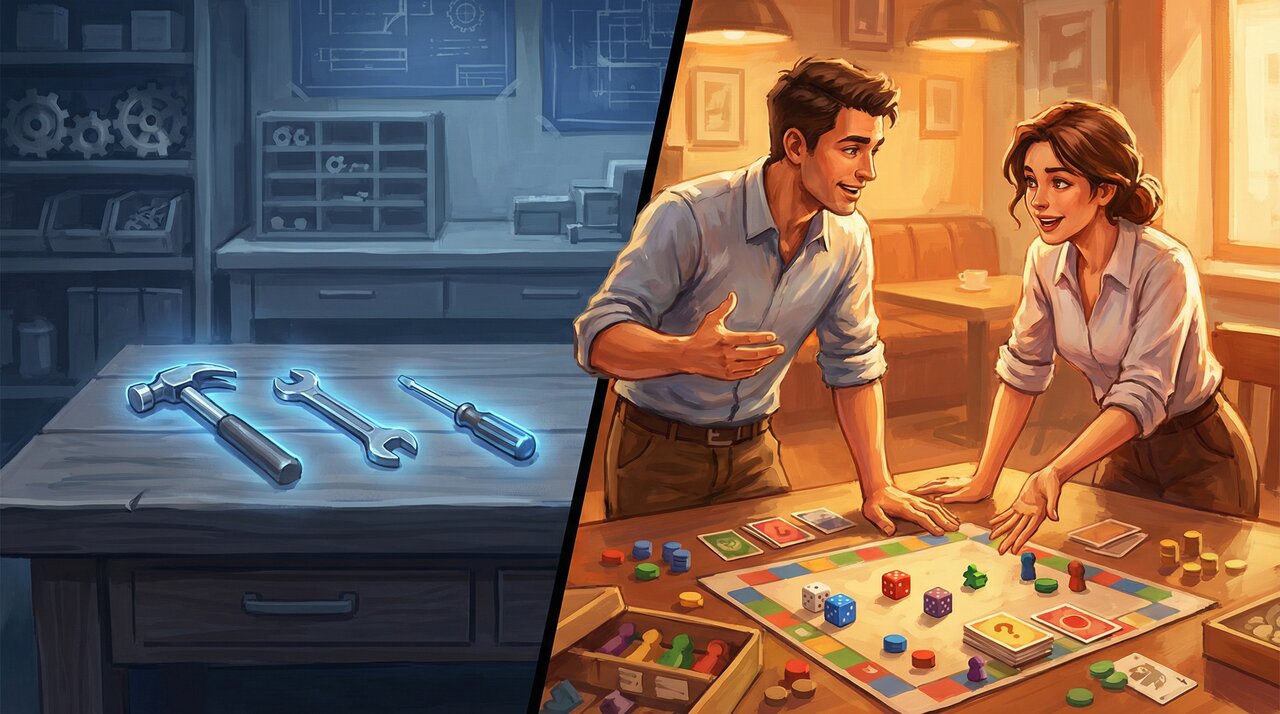
Figure. Left: a workbench with tools laid out neatly, each use independent. Right: two collaborators in conversation, context accumulating between them. The shift from toolbox to colleague is the shift from stateless to stateful.
| Before Nova | With Nova |
|---|---|
| Click “Fix” on a critique issue | “The scoring curve feels flat” |
| Type intent in a modal | “Make this less punishing at 4 players” |
| Click “Get Suggestions” | Nova proactively surfaces ideas in conversation |
| Click “Regenerate” on a stale section | “The synergies feel outdated after our last change” |
| Click “Re-Evaluate” to score | “How did that change affect the balance?” |
The designer never sees agent names. They never select a mode. They talk to Nova. Nova decides which specialist to invoke, collects the results, and presents them as a coherent conversational response. The orchestration is invisible.
Nova is a conversational layer on top of a multi-agent pipeline: six specialist agents, a structured game ontology, a reference library of 2,000 published games, and a persistent memory of every decision you have made, all accessible through natural language [5]. The shift from toolbox to colleague is the shift Mollick describes in Co-Intelligence [6]: treating AI not as a productivity shortcut but as a collaborative partner with its own contributions to the work.
The Reinforcement Learning Loop
Here is the idea at the center of Nova, the reason it is more than a chat interface. Every interaction with Nova feeds a cycle that makes the next interaction better.
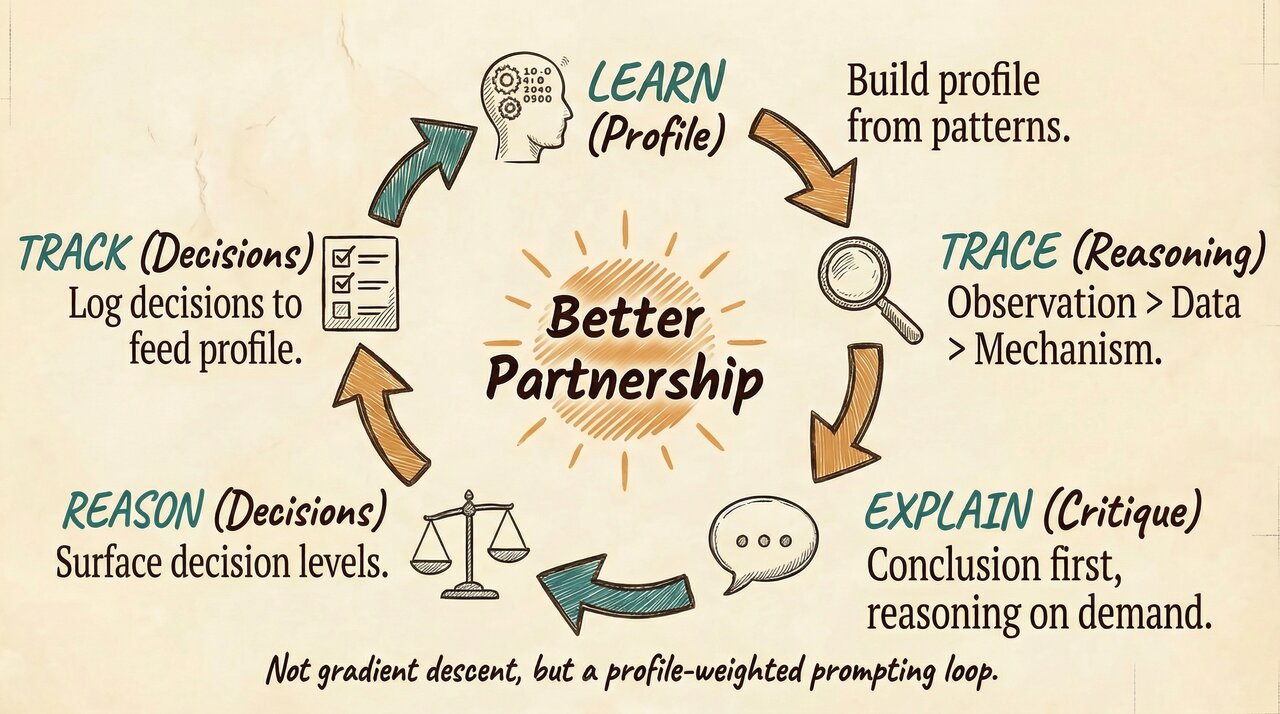
Figure. The five-stage reinforcement learning cycle at Nova’s core. Learn builds a profile from your decisions. Trace captures reasoning chains. Explain presents conclusions with evidence. Reason surfaces intervention options at different levels of abstraction. Track records every decision. The cycle closes: tracked decisions feed the learning profile, and the partnership improves with use.
Learn. Nova builds a profile of your design preferences from the pattern of what you accept and reject across sessions. Mechanism affinities, complexity tolerance, theme preferences, interaction style, risk appetite. Recent choices weigh more, but old patterns do not vanish overnight.
Trace. When Nova analyzes your design, it traces a reasoning chain: observation (what was measured), data (the specific numbers), mechanism (the game structure causing the pattern), and impact (what breaks downstream). The designer sees not just “this is unbalanced” but the full evidence trail that led there.
Explain. Nova presents the conclusion first, for quick scanning. The reasoning chain is always available. The designer can ask “Why?” and get the forensic breakdown. This mirrors how a real design partner works: they tell you the problem, and you ask clarifying questions when you need the depth.
Reason. After presenting the evidence, Nova surfaces decision levels, a menu of intervention strategies at different levels of abstraction:
| Decision Level | What It Means | Example |
|---|---|---|
| Structural | Redesign the mechanism or flow | Change how rounds scale with player count |
| Numerical | Adjust parameters or thresholds | Tune the draw rate or pool growth formulas |
The designer chooses which level to operate at. This is the actual lead-designer decision: not “fix the problem” but “at what level should I intervene?”
Track. Every decision, whether accepted, rejected, or deferred, is recorded in a structured decision log linked to the game’s version history. When the designer returns tomorrow, Nova reconstructs context from the current game state plus the decision log. The designer picks up where they left off.
The cycle closes. Tracked decisions feed the learning profile. The profile shapes future proposals. Better proposals lead to more informative accept/reject signals. The partnership improves with use.
The conversation gets smarter with every decision you make.
Not a Copy of You
The first instinct with personalization is to make Nova a mirror. Learn what the designer likes, propose more of it. This is a trap. Donald identified it immediately:
“Nova could be uniquely helpful because it learns and proposes things in a way I would, BUT it isn’t locked into particular taste patterns. It’s like how when you want to build a powerful team, you add people who understand you and what you are trying to do, but aren’t copies of you.”
A designer with 30 years of experience has powerful pattern recognition, but also powerful pattern lock-in. They reach for familiar solutions because those solutions have worked before. The value of a good collaborator is not “me but faster.” It is “me but with fresh eyes.” Someone who understands your intent and quality bar but is not constrained by your habitual approaches.
Nova’s designer profile captures intent and standards, not habits. What you care about (theme coherence, elegant mechanisms, tight player interaction), beyond what you usually do (engine building, indirect competition, medium complexity). The best proposals are the ones you would not have thought of but immediately recognize as right.
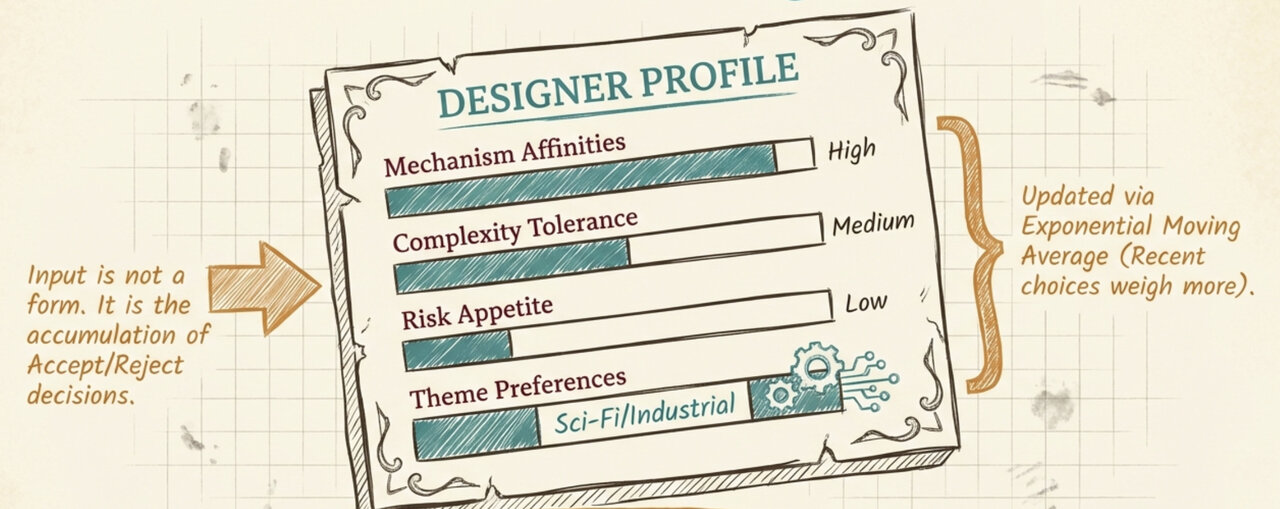
Figure. The designer profile is the accumulation of accept/reject decisions, updated via exponential moving average so recent choices weigh more.
To prevent convergence, Nova deliberately introduces creative tension. Most proposals align with your demonstrated preferences. But some push one step outside your comfort zone, combining something familiar with something you have not tried. And occasionally, Nova throws a genuine curveball from a part of the design space you have never touched.
If you consistently accept the curveballs, Nova throws more of them. If you consistently reject them, it pulls back. The system learns how adventurous you are feeling.
The result is a collaborator who gets you but does not become you:
“I know you usually go for engine building here, but have you considered a negotiation mechanism? It pairs with the worker placement in a way that creates the indirect competition you prefer, but through a mechanism you have not explored.”
And you think: huh, that is actually interesting.
Show Your Thinking
The most requested upgrade from experienced designers was not more features. It was more transparency. Donald articulated the frustration precisely:
“I wish I had more information. Not always knowing HOW or WHY Nova highlighted something. I was in a game jam, I could ask the game developer ‘what did you see that led you there?’ Some critiques are just obvious because I’m inferring the reasoning, but it’s definitely me inferring.”
For a casual designer building a game for their nine-year-old, “player count scaling is too punitive at high counts” is enough. For an experienced designer planning a commercial release, the reasoning behind the critique is more valuable than the critique itself. The conclusion confirms what they already suspect. The evidence chain is what they need to make the right structural decision.
Compare the two experiences. Without Nova, you hear “this level feels off” and spend an afternoon tracing why. With Nova, you hear “player count scaling is too punitive because CPU costs outpace Focus generation, creating dominant strategies around low-cost cards,” and you jump straight to the fix.
Nova acts like a Lead Designer preparing a brief for a Creative Director. The value is not raw data. It is the synthesis of data into strategic insight, so the designer stays at the level where their judgment matters most.
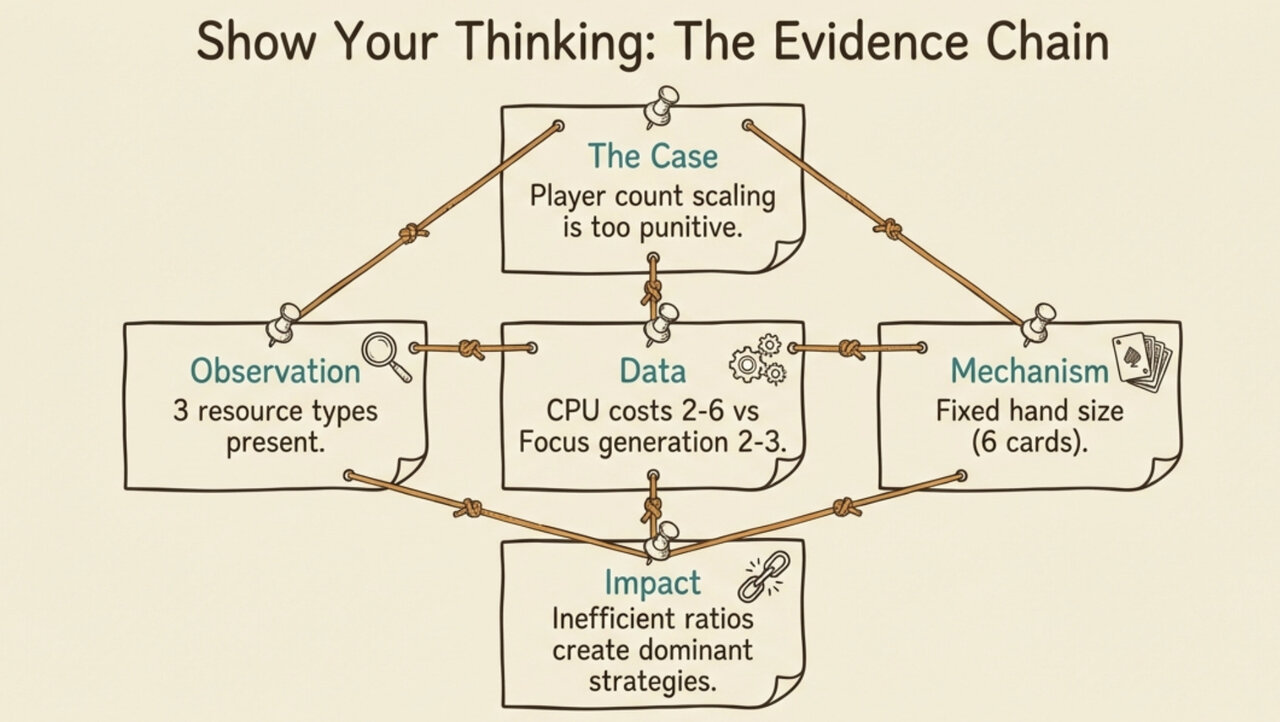
Figure. An expanded critique reasoning chain. The conclusion is for quick scanning. The chain traces from observation through data and mechanism to impact. The decision buttons at the bottom let the designer choose the level of intervention: restructure the mechanism, or tune the numbers.
Nova’s critique reasoning chains follow a structured format:
Conclusion: The resource economy has structural imbalances around CPU costs and Focus token generation.
Reasoning Chain:
- Observation: The game uses three main resource types with different generation and consumption rates
- Data: CPU costs range from 2-6, Focus generation is 2-3 per round, alarm escalation is +1/+2 per incident
- Mechanism: Fixed hand size (6 cards) with exactly 3 programmed actions creates a constrained economy where CPU efficiency determines available options
- Impact: Inefficient CPU ratios create dominant strategies around low-cost cards; insufficient Focus generation makes coordination failures inevitable rather than skillful
Approach: [Restructure] [Tune Numbers]
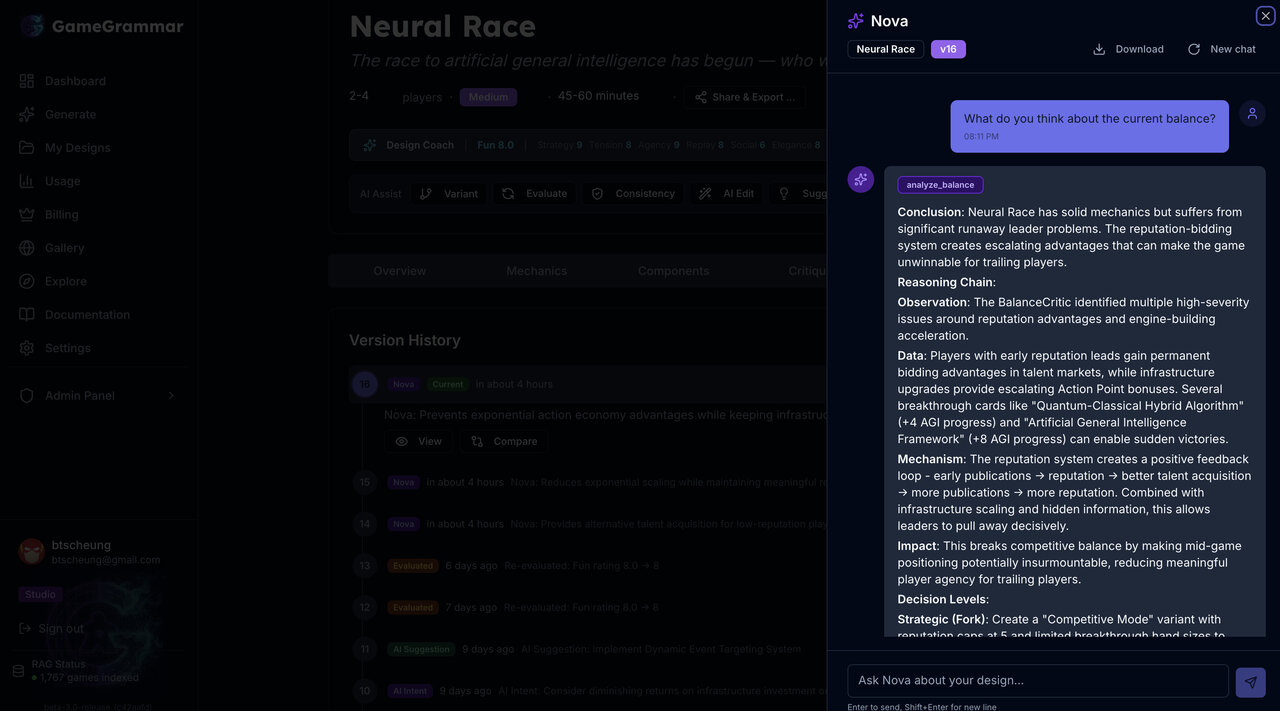
Figure. Nova analyzing the balance of Neural Race inside GameGrammar. The full reasoning chain, from observation through mechanism to impact, surfaces alongside decision levels and a version history trail of every Nova-applied change.
The conclusion is for quick scanning. The chain is for deep analysis. The approach buttons are for action. This mirrors how the best design conversations work in a professional studio: someone identifies the problem, explains why it is a problem, and presents the structural options for resolution. The lead designer chooses which level to intervene at.
Without the reasoning chain, you get one thing to react to. With it, you see the full decision tree. Do you redesign the round structure? Or do you just tune the draw rate? Those are fundamentally different design decisions at different levels of abstraction, and the lead designer is the one who should choose which level to operate at.
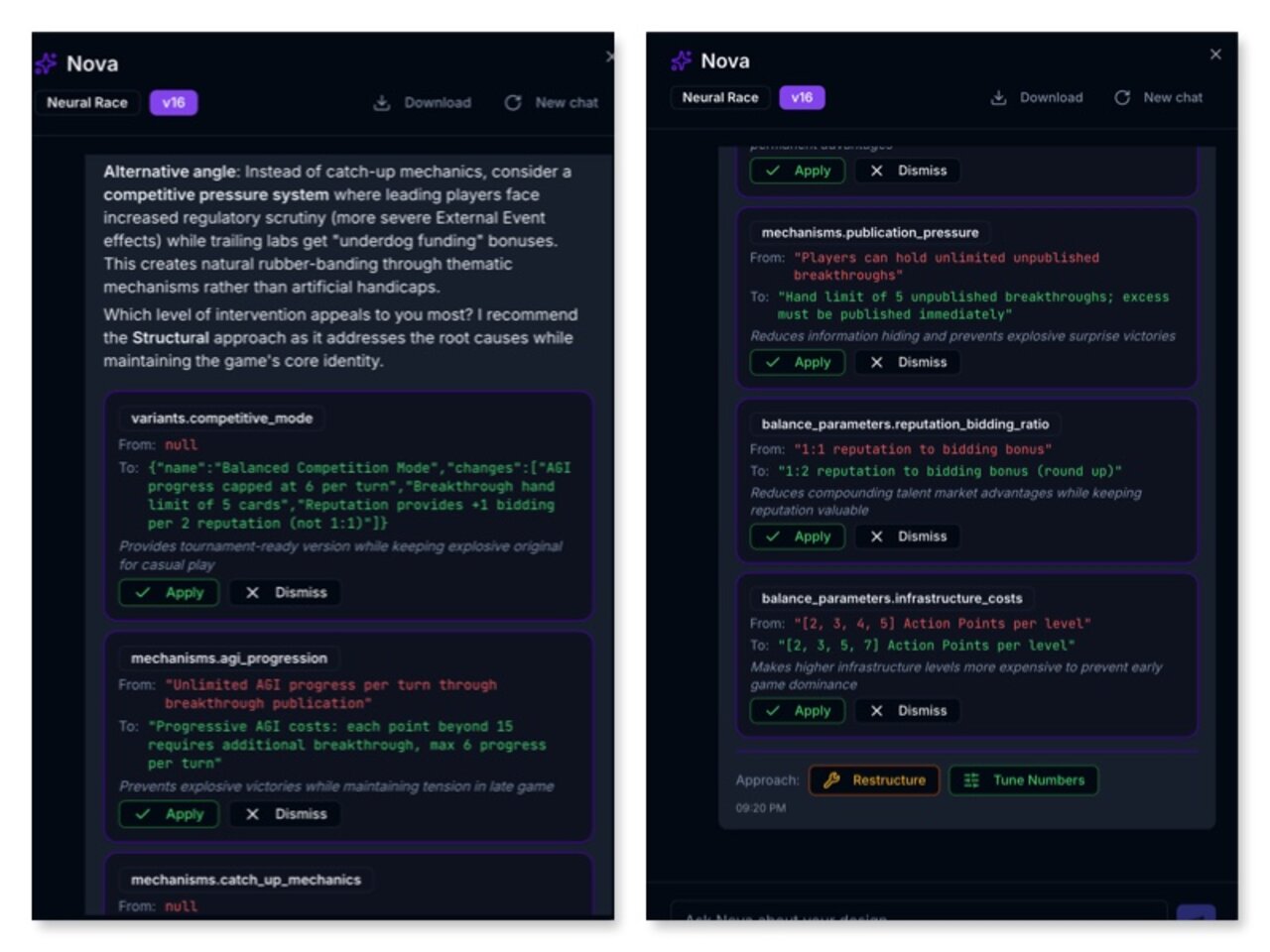
Figure. Nova presenting concrete change proposals after a structural intervention. Each proposal shows the exact ontology path, old value, new value, and rationale. The designer clicks Apply or Dismiss on each one individually.
The Architecture: Orchestration, Not Invention
Nova’s power comes from unification, not from new AI capabilities. The same specialist agents that power GameGrammar’s button-click interface also power Nova. The difference is the interaction model.
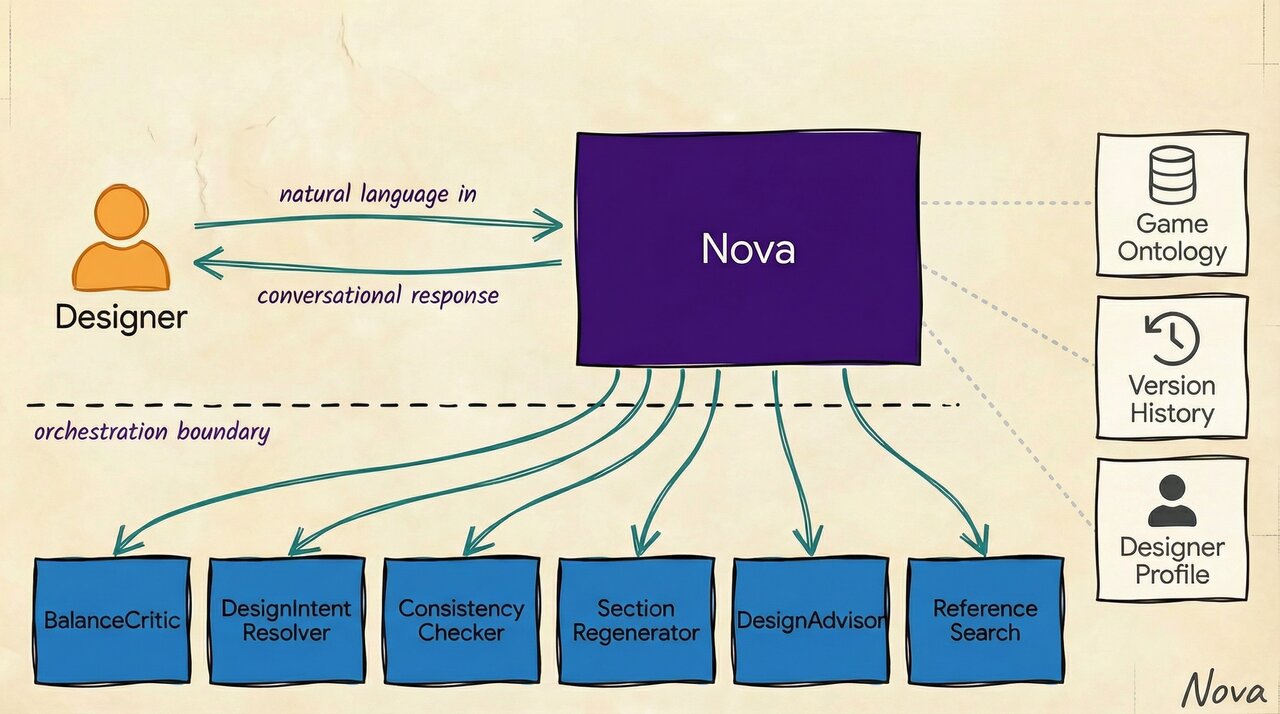
Figure. Nova sits as a conversational orchestration layer on top of six specialist agents. The designer talks to Nova in natural language. Nova routes to the appropriate agent, collects structured results, and synthesizes them into a conversational response with change proposals and decision options.
Nova uses intent capability to decide which agent to invoke. The designer’s natural language is the input. Nova’s system prompt includes tool definitions for all available agents: balance analysis, design intent resolution, consistency checking, section regeneration, design suggestions, and reference game search. The model decides which tools to call based on the conversation context, the same way it decides which tools to use in any other agentic workflow.
This architecture has a crucial property: the AI capabilities are already proven in production. The BalanceCritic has been analyzing games for months. The DesignIntentResolver has been translating plain-language edits into ontology patches. Nova does not introduce new capabilities that might hallucinate in novel ways. It wraps trusted agents in a conversational interface with memory.
The agents run as tool calls within Nova’s conversation loop. When the designer says “make this less punishing at four players,” Nova does not try to solve the problem from first principles. It invokes the BalanceCritic to analyze the specific scaling issue, then invokes the DesignIntentResolver to translate the fix into a concrete ontology patch. The result is grounded in the same structural analysis that the button-click interface uses, but presented conversationally with reasoning.
The zero-write principle still holds. Nova proposes changes but never writes to the database without explicit designer approval. Every change proposal shows the exact path, old value, new value, and rationale. The designer clicks Apply or Dismiss. Applied changes go through the same version history system as manual edits, creating a traceable record. This is not a safety net. It is a statement of values: Nova suggests, but the designer remains the sole author.
Memory Without Replay
Nova remembers across sessions the way a good colleague does. Not by replaying every conversation verbatim, but by holding a mental model of the project: where it stands, how it got here, and what matters to you.
Nova assembles four things: the current game state, recent version history, your last decisions, and your designer profile. That is enough to pick up where you left off.
When the designer opens a new session, Nova generates a greeting that references the design’s evolution:
“Welcome back. Your game is at v7. Last session we settled on worker placement + deck building as the core loop and tuned the hand limit from 7 to 6. The current balance parameters show combo probability at 28%. You mentioned wanting to explore adding player interaction. Want to pick up there?”
The designer does not re-explain anything. Nova already knows.
Grounded in Your Design
The trust between Nova and the designer rests on a shared source of truth: the game ontology [3]. Nova does not guess about your design. It reads the same structured data you see. This grounding produces four properties that make the partnership reliable.
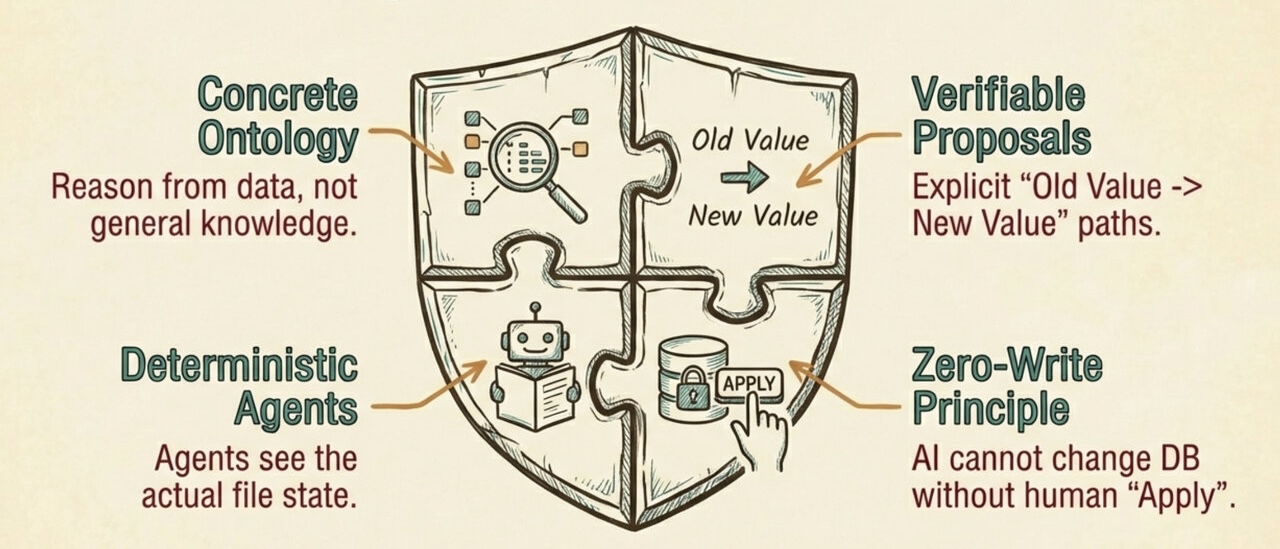
Figure. Four interlocking properties that keep Nova grounded: concrete ontology, verifiable proposals, transparent audit trail, and designer authority.
Grounded analysis. When the designer asks “is my resource economy balanced?”, Nova does not reason from general game design principles. It reads the actual ontology: the specific resource types, generation rates, consumption patterns, and player count scaling that exist in this design. The analysis is grounded in data, not conjecture.
Verifiable proposals. Every change proposal includes the exact path, old value, and new value. balance_parameters.focus_per_round: "2-3 tokens" → "3-4 tokens" is immediately checkable against the current design state. The designer can verify at a glance that Nova is operating on real data.
Transparent audit trail. When Nova invokes BalanceCritic, it passes the full current ontology. The reasoning chain traces from observable data to conclusions, creating version control for ideas. Every step is traceable.
Designer authority. Nova suggests, you decide. Every change requires explicit approval. The version history preserves every previous state. Nothing changes without consent.
The result is a system where the designer can trust Nova’s analysis because it is grounded in the same data the designer sees, and can trust that nothing changes without their approval.
Concluding Remarks
Nova transforms GameGrammar (Studio tier) from a design tool into a design partnership. The designer still provides the vision, the taste, the intention. The system still provides the structural analysis, the mechanism knowledge, the rapid iteration. But the interface between them is no longer a set of buttons and forms. It is a conversation that accumulates context, learns preferences, explains its reasoning, and improves with use.
The reinforcement learning loop is what makes this different from “we added a chatbot to our product.” Every accept/reject decision shapes the profile. The profile shapes future proposals. Better proposals produce more informative signals. The cycle compounds. After 50 decisions, Nova knows things about your design taste that you might not have articulated yourself. After 100, it starts proposing mechanism combinations that you would not have considered but that fit your aesthetic perfectly.
This is the new era of design assistance that works alongside you, session after session, building a shared understanding of what you are trying to create and how to get there.
The grammar does not write the poem [1]. But with Nova, the grammar remembers your voice.
Series
- Unlocking the Secrets of Tabletop Games Ontology (Part 4)
- Introducing GameGrammar: AI-Powered Board Game Design (Part 5)
- GameGrammar: The Theory of Generative Board Game Design (Part 6)
- » Nova: The AI Co-Designer That Learns Your Taste (Part 7)
References
[1] Alfred North Whitehead. Process and Reality. Free Press, 1929/1978.
[2] Benny Cheung. GameGrammar: The Theory of Generative Board Game Design. bennycheung.github.io, Feb 2026.
- The design theory that Nova builds upon: structured vocabulary, multi-agent generation, and the co-design partnership
[3] Benny Cheung. Generative Ontology: When Structured Knowledge Learns to Create. arXiv:2602.05636, Feb 2026.
- The formal paper describing GameGrammar’s generative ontology framework
[4] Dynamind Research. Research and product development studio.
- Creator of GameGrammar
[5] GameGrammar. Board game design platform.
- The product where Nova lives: structured ontology, multi-agent generation, and conversational co-design
[6] Ethan Mollick. Co-Intelligence: Living and Working with AI. Penguin, 2024.
- The framework for treating AI as a collaborative partner rather than a tool, central to Nova’s design philosophy