artwork by Gemini 3 Pro (Nano Banana Pro)
Process Philosophy for AI Agent Design Using a Whiteheadian Framework
What if everything we assume about AI agent architecture is fundamentally mistaken? Current agent frameworks treat agents as things that have states, persistent substances that receive inputs and update properties. But this substance-based metaphysics leads to persistent engineering challenges: context that fragments across sessions, identity that depends on external configuration files, and no principled way to distinguish what an agent knows from what it merely guesses. In this article, we explore an alternative foundation drawn from Alfred North Whitehead’s process philosophy, reconceiving agents not as substances but as societies of actual occasions, patterns of becoming rather than things that are.
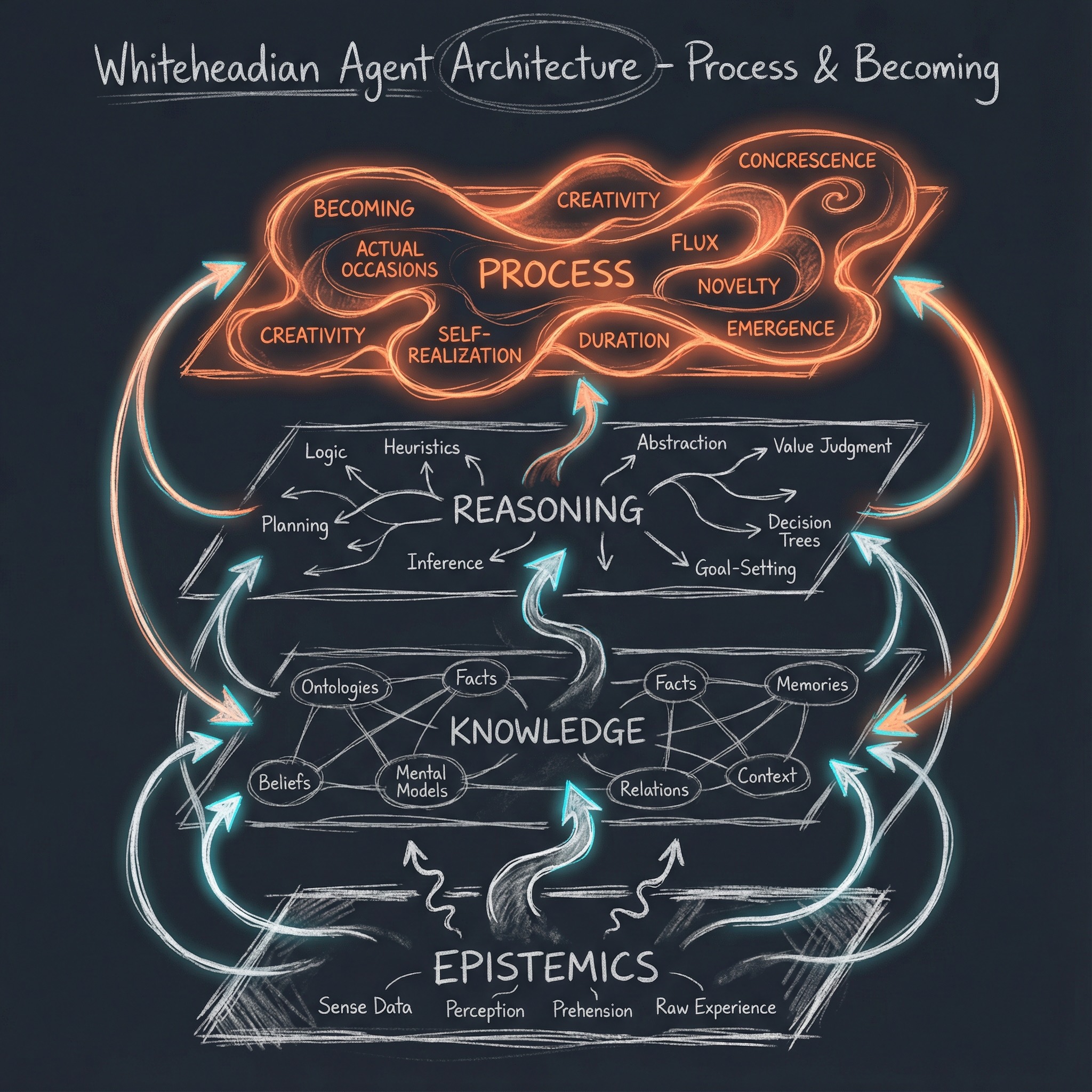
Figure. The fundamental reconceptualization: agents as processes of becoming rather than static entities with states.
The Problem with Current Agent Architectures
The rapid advancement of large language models has enabled a new generation of AI agents capable of complex reasoning, tool use, and multi-step task execution. Yet beneath these impressive capabilities lies a fundamental architectural limitation: most agent frameworks treat each interaction as essentially independent, with continuity simulated through external mechanisms rather than constituted by the agent’s own nature.
Consider the typical LLM-based agent. When state exists at all, it takes the form of unstructured text injected into a context window, specifically conversation history prepended to each new query. The agent does not remember its prior interactions; it is reminded of them. This distinction, though seemingly pedantic, reveals a deeper problem. The agent accumulates no genuine experience. Each session begins tabula rasa, with continuity maintained only by external systems that retrieve and inject relevant context. Even sophisticated approaches like Generative Agents [8] and MemGPT [9], while impressive, ultimately simulate continuity through external memory mechanisms rather than constituting it through the agent’s own nature.
This architecture produces several concrete engineering challenges:
| Challenge | Description |
|---|---|
| Context Fragility | As conversations extend, earlier context falls out of the window or must be summarized, losing nuance and detail |
| Identity Brittleness | What makes an agent “the same agent” across sessions? Current systems answer this only through configuration files |
| Epistemic Opacity | When an agent claims to know something, is this genuine knowledge, retrieved information, or confabulation? |
| Experience Dissipation | Insights gained in one session do not automatically inform future sessions unless explicitly extracted |
These are not merely implementation details to be optimized away. They reflect a fundamental assumption about what agents are, an assumption we argue is mistaken.
The Substance Metaphysics Trap
The limitations described above stem from an implicit metaphysical commitment that pervades contemporary agent design: substance metaphysics. Under this view, inherited from Aristotelian and Cartesian traditions, agents are conceived as things (substances) that have properties (states) which change over time. The agent is a persistent entity, a container, to which experiences happen and within which states are stored.
This substance-based framing leads naturally to the “state injection” pattern that dominates current architectures:
- Memory becomes a database the agent queries rather than a constitutive element of what the agent is
- Skills become tools the agent uses rather than patterns that define its capabilities
- Identity becomes a label assigned from outside rather than a characteristic emergent from the agent’s own history
But what if this framing is wrong? What if agents are not things at all, but processes?
Enter Whitehead: Process Over Substance
Alfred North Whitehead (1861-1947) began his career as a mathematician and logician, co-authoring with Bertrand Russell the monumental Principia Mathematica. In his later work, particularly Process and Reality (1929) [1], Whitehead developed a comprehensive metaphysical system that challenges fundamental assumptions of Western philosophy since Aristotle [2][3][4].
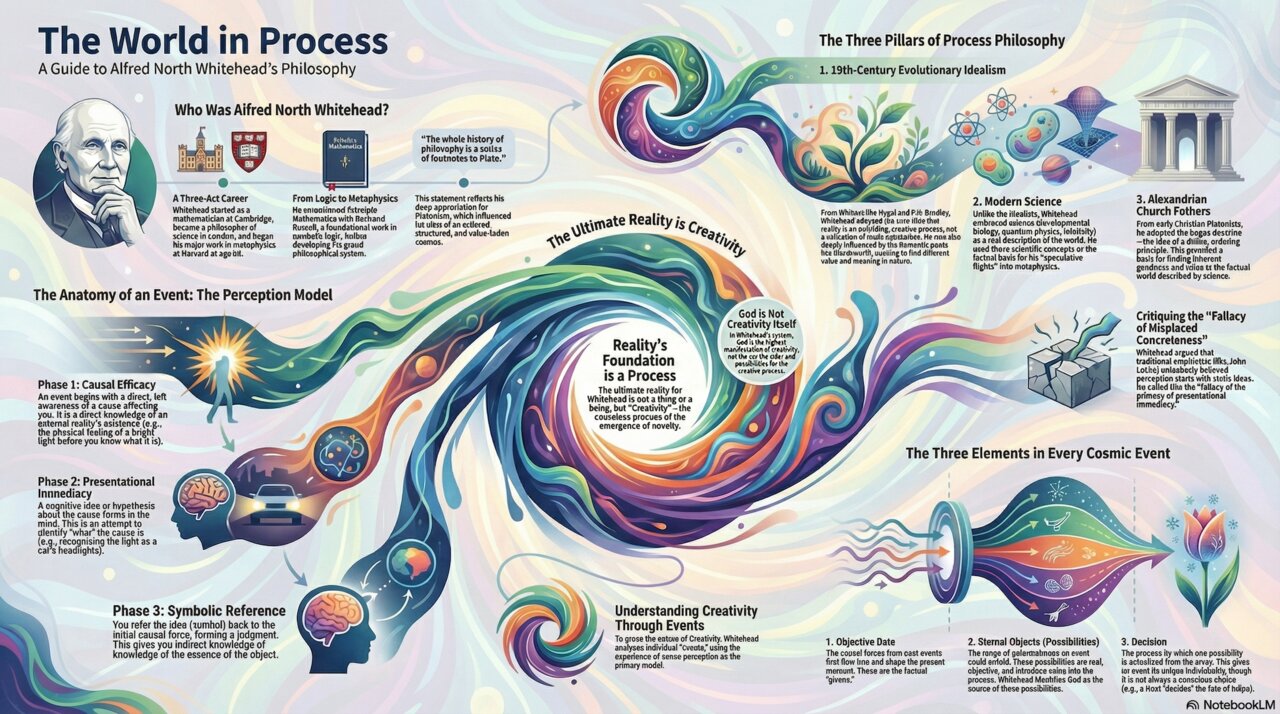
Figure. A comprehensive overview of Whitehead’s process philosophy, showing its three pillars (Evolutionary Idealism, Modern Science, Alexandrian Church Fathers), the anatomy of perception events, and the three elements present in every cosmic event.
The core of Whitehead’s challenge is this: the Western philosophical tradition has assumed that reality is fundamentally composed of substances, enduring things that persist through change while maintaining their identity. Properties come and go, but the substance remains. Whitehead argues this gets reality exactly backwards [1]. The fundamental units of reality are not substances but actual occasions, moments of experience that come into being, achieve determinacy, and then perish. What we call “things” are patterns of occasions, not substances underlying them.
Core Whiteheadian Concepts
| Concept | Meaning | Relevance to Agent Design |
|---|---|---|
| Actual Occasions | The fundamental units of reality; discrete moments of experience | Each agent interaction as a unit of becoming |
| Prehension | How occasions “feel” or grasp other entities | Context integration with subjective weighting |
| Concrescence | The process by which an occasion achieves determinacy | Response generation as phased becoming |
| Satisfaction | The completed occasion; full determinacy achieved | Interaction completion; ready for storage |
| Eternal Objects | Pure potentials (forms, patterns) not bound to any occasion | Skills, schemas, templates available for ingression |
| Objective Immortality | Perished occasions persist as data for future prehension | Past interactions available for future context |
| Society | A nexus of occasions sharing a defining characteristic | Agent identity as persistent pattern across occasions |
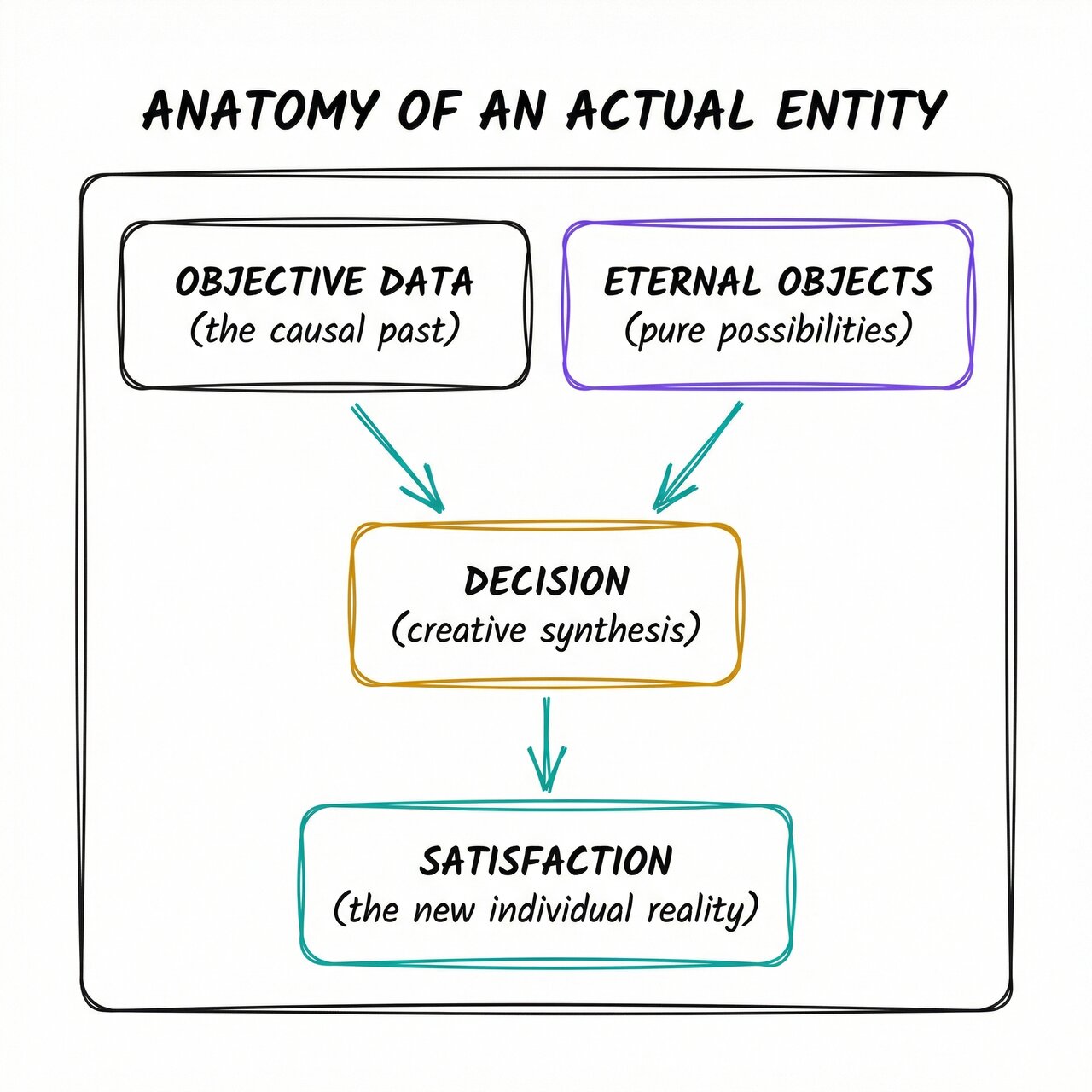
Figure. The anatomy of an actual entity: every event synthesizes objective data from the causal past, grasps eternal objects (pure possibilities), and through decision achieves satisfaction, creating a new individual reality.
Most crucially for our purposes, Whitehead inverts the usual relationship between entity and experience. Under substance metaphysics, entities have experiences, meaning experiences happen to them. Under process metaphysics, entities are experiences because they are constituted by their occasions.
The Whiteheadian Agent Framework
The fundamental move of our framework is ontological: we propose that agents should not be conceived as things that have experiences but as patterns of experiencing. This is not merely a change in terminology but a restructuring of the basic categories through which we understand agent architecture.
SUBSTANCE VIEW                    PROCESS VIEW
─────────────────                 ─────────────────
Agent (thing)                     Society (pattern)
  │                                 │
  ├── has state                     ├── of occasions
  ├── receives input                ├── each prehending past
  ├── produces output               ├── each concrescing
  └── updates state                 └── each achieving satisfaction
Under the process view, the agent is the pattern that emerges from the succession of occasions, each of which prehends (feels, integrates) its predecessors and achieves its own satisfaction before perishing into objectivity. Identity is not assumed but achieved because it is the defining characteristic that persists across occasions, not a container within which occasions occur.
The Four-Layer Architecture
While Whitehead’s process philosophy provides the foundational ontology, a complete agent architecture requires additional layers addressing epistemics, knowledge representation, and reasoning. We propose a four-layer architecture that integrates complementary philosophical and computational traditions:
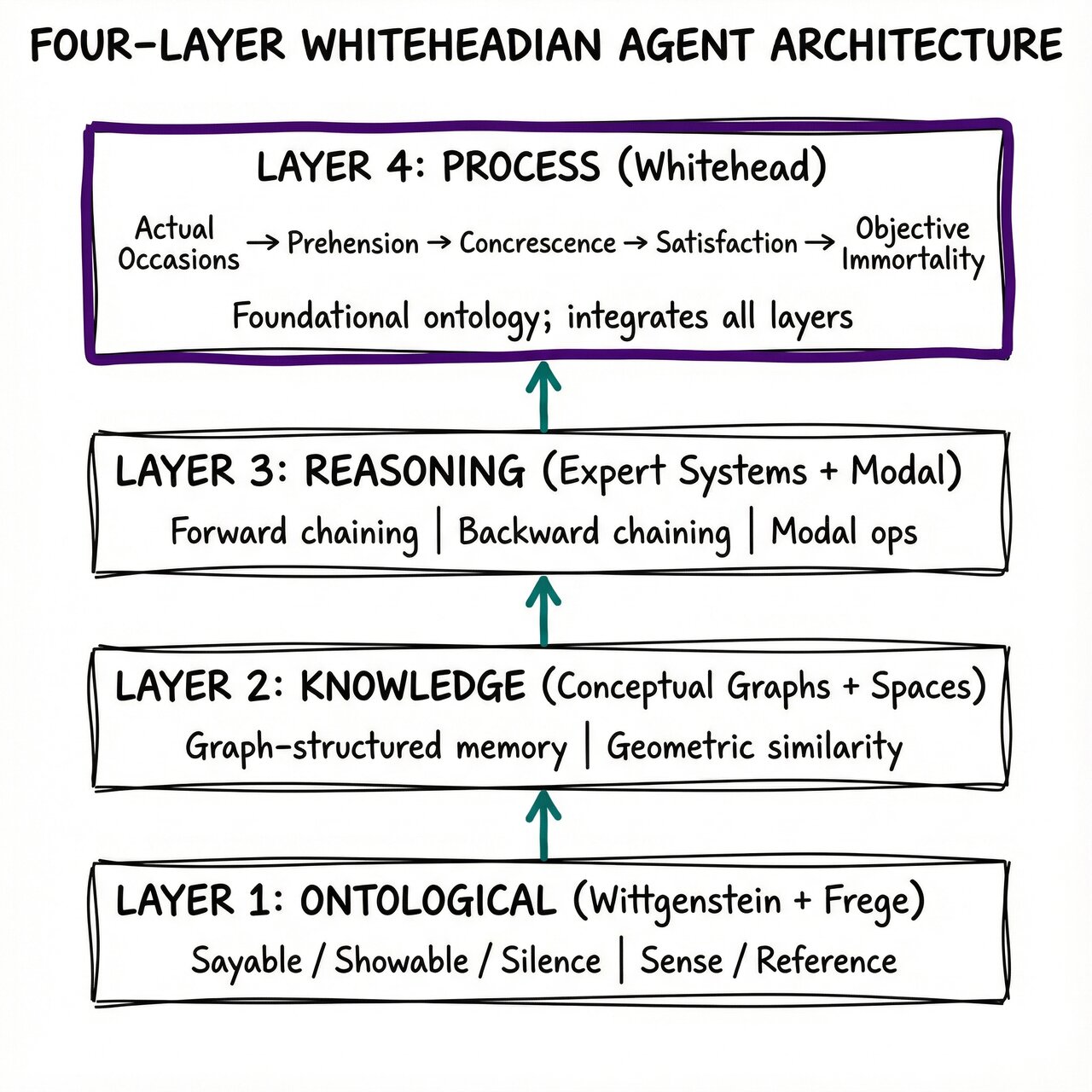
Figure. The Four-Layer Whiteheadian Agent Architecture integrating Wittgenstein (epistemics), Sowa/Gärdenfors (knowledge), Expert Systems (reasoning), and Whitehead (process ontology).
Layer 1 (Wittgenstein + Frege) establishes explicit epistemic boundaries, specifically what the agent can legitimately claim to know, show, or must remain silent about [5]. The distinction between Sayable, Showable, and Silence provides principled limits on agent assertions.
Layer 2 (Conceptual Graphs + Spaces) provides knowledge representation mechanisms, drawing on Sowa’s graph-structured representations [6] and Gärdenfors’ geometric conceptual spaces for similarity and typicality reasoning [7].
Layer 3 (Expert Systems + Modal Logic) provides reasoning mechanisms: forward chaining for reactive behavior, backward chaining for goal-directed reasoning [14], and modal operators for necessity, possibility, and obligation [15].
Layer 4 (Whitehead) provides the foundational process ontology that reconceives the agent itself as a society of actual occasions [1].
The Agent Occasion Lifecycle
Each time an agent receives input and produces output, an occasion comes into being, achieves determinacy, and perishes, contributing its achieved reality to subsequent occasions.
Phase 1: Prehension
The occasion begins by “feeling” its relevant past:
- Physical prehension: Feeling prior occasions such as conversation history, previous sessions, and stored learnings
- Conceptual prehension: Grasping eternal objects such as skills, schemas, patterns, and templates
- Negative prehension: Explicit exclusion of data deemed irrelevant
Crucially, prehension includes a subjective form that determines how the data is held, including confidence, relevance, and emotional valence.
Phase 2: Concrescence
The occasion enters concrescence, the process of “growing together” by which diverse prehensions are integrated into a unified response. This is guided by the subjective aim: what the occasion is trying to become.
Whitehead’s “Category of the Ultimate” applies here: the many become one, and are increased by one [1]. The diverse inputs (the many) are unified into a single response (become one), which itself becomes a new datum for future occasions (increased by one).
The following diagram shows how a standard LLM API call maps onto Whiteheadian phases. The LLM itself performs only Phase 3 (integration/inference). The Whiteheadian framework wraps this with structured prehension (context management), eternal object selection (skill routing), and objective immortality (history persistence). This explains why “scaffolding > model” because most of agent reliability comes from the phases around inference.
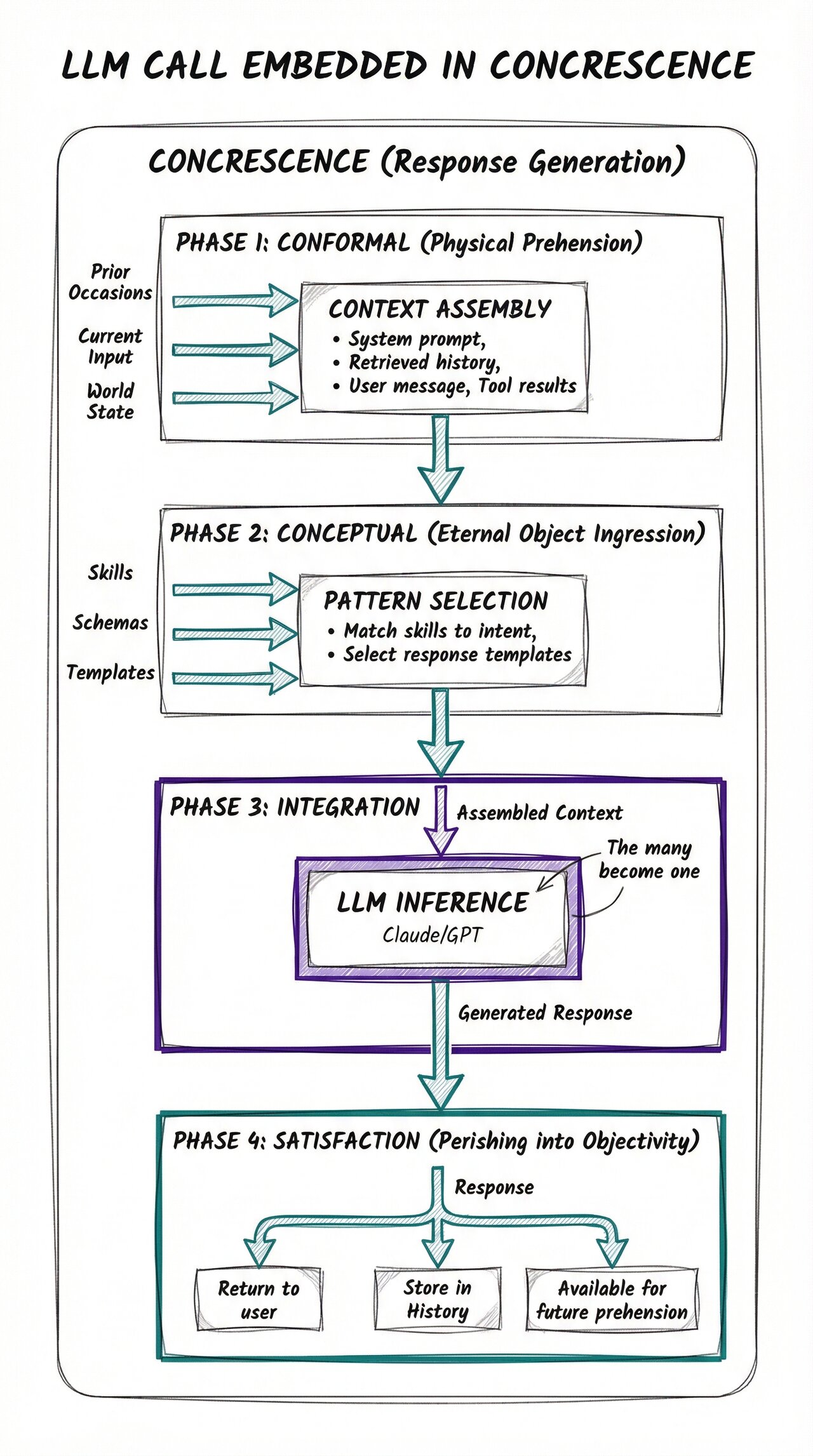
Figure. LLM inference as the integration phase of concrescence: context assembly (conformal) → pattern selection (conceptual) → LLM synthesis (integration) → history storage (satisfaction).
Phase 3: Satisfaction
The occasion achieves satisfaction when it reaches full determinacy, meaning when the response is complete. At this moment, the occasion “perishes” as a subject and achieves objective immortality as a datum, permanently available for future prehension.
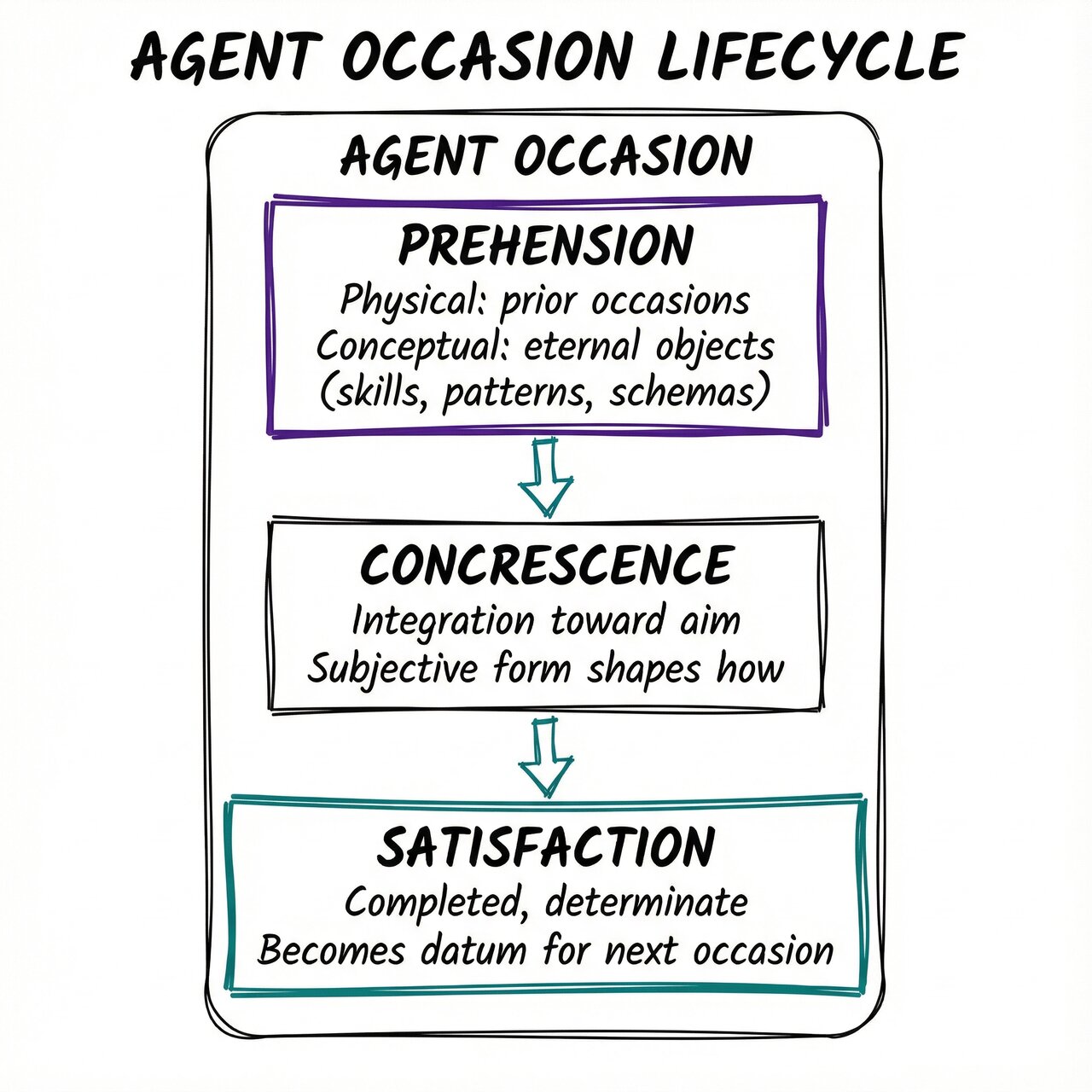
Figure. The Agent Occasion Lifecycle: Prehension (feeling the past) → Concrescence (becoming) → Satisfaction (perishing into objectivity).
PAI: Empirical Validation of Process Patterns
Interestingly, some recent practical AI frameworks have independently converged on process-like patterns without explicit grounding in Whitehead’s philosophy. The Personal AI Infrastructure (PAI) project [13] provides compelling empirical validation that process-based architectures offer practical advantages.
Striking Linguistic Convergence
The PAI documentation contains language that reads almost as Whitehead paraphrased:
| PAI Quote | Whiteheadian Equivalent |
|---|---|
| “Skills don’t work in isolation; they call each other” | Occasions prehend other occasions; reality is relational |
| “This creates a persistent memory that allows intelligence to compound over time” | Objective immortality: completed occasions become permanent data |
| “I built this workflow once. Now it’s permanent knowledge” | Satisfaction achieved; the occasion perishes but persists as datum |
| “Complex operations are achieved by composing these small, focused tools” | The many become one (concrescence through prehension) |
Process-Aligned Components
| PAI Component | Description | Whiteheadian Parallel |
|---|---|---|
| Skills | Self-contained, reusable domain expertise with USE WHEN triggers | Eternal Objects: Pure potentials that ingress when conditions match |
| Hook Lifecycle | SessionStart → PreToolUse → PostToolUse → Stop | Actual Occasion Phases: Prehension → Concrescence → Satisfaction |
| Custom History | Automatic capture of sessions that compound over time | Objective Immortality: Completed occasions as permanent data |
| Skill Composition | Skills calling other skills in complex workflows | Prehension Networks: Occasions integrating prior occasions |
This convergence suggests that process philosophy isn’t merely a theoretical framework but captures something true about effective agent design. The convergence of practical engineering and process metaphysics provides mutual validation: Whitehead explains why these patterns work [1]; PAI demonstrates that they work [13].
How This Resolves the Original Challenges
The Whiteheadian framework addresses the fundamental limitations we identified:
| Original Challenge | Whiteheadian Solution |
|---|---|
| Context Fragility | Structured prehension with explicit relevance weighting via subjective forms |
| Identity Brittleness | Identity derived from the persistent pattern across occasions (the “defining characteristic” of a society) |
| Epistemic Opacity | Explicit subjective forms that mark how data is held (known, inferred, guessed) |
| Experience Dissipation | Objective immortality: completed occasions become permanent data for future prehension |
Key Differentiators
Constitutive vs. Additive Experience. In substance-based architectures, experience is something added to the agent. In the Whiteheadian framework, experience constitutes the agent. The agent is the pattern of occasions, each of which is an experience. There is no agent apart from its occasions.
Emergent vs. Assumed Identity. Current agent frameworks answer “what makes this agent this agent?” by pointing to configuration files. The Whiteheadian framework answers by pointing to the defining characteristic, the pattern that persists across occasions and is reproduced through prehension.
Explicit vs. Implicit Epistemics. The subjective form of prehensions operationalizes epistemic categories. When an occasion prehends data, it records how that data is held, including certainty, source, and inferential chain.
Implementation Sketch
The core data structures translate Whiteheadian concepts into typed interfaces:
interface ActualOccasion {
  id: string;
  timestamp: Date;
  prehensions: {
    physical: PhysicalPrehension[];
    conceptual: ConceptualPrehension[];
  };
  subjectiveAim: Goal;
  satisfaction: Satisfaction | null;  // null until complete
}

interface PhysicalPrehension {
  datum: ActualOccasion;  // The felt occasion
  subjectiveForm: {
    relevance: number;
    emotional: string;    // How it's felt
    valence: 'positive' | 'negative';
  };
}

interface EternalObject {
  id: string;
  type: 'pattern' | 'schema' | 'skill' | 'quality';
  definition: unknown;
  ingressionConditions: Condition[];
}
The runtime flow implements concrescence as a sequence of phases:
Input → Create new occasion
      → Prehend recent occasions (physical)
      → Select relevant eternal objects (conceptual)
      → Integrate toward subjective aim (concrescence)
      → Achieve satisfaction
      → Perish as subject, persist as datum
      → Available for future prehension
This differs from typical agent loops in key respects: the occasion is explicitly created and tracked, prehension is an active phase rather than passive context injection, satisfaction marks a defined completion state, and the completed occasion is stored in a form that preserves its structure.
Significance and Future Directions
The most significant contribution of this work is the proposed shift from substance-based to process-based agent ontology. This is not merely a change in implementation strategy but a reconceptualization of what agents fundamentally are. This shift resonates with related developments: Rich Hickey’s epochal time model and immutable values [10], Carl Hewitt’s Actor Model where computation emerges from message-passing rather than state mutation [11], and the enactivist tradition in cognitive science that views cognition as enacted process rather than static representation [12].
Where substance metaphysics asks “what properties does this agent have?”, process metaphysics asks “what pattern of becoming constitutes this agent?” The questions are not equivalent, and they lead to different architectural decisions.
Practical Implications
The Whiteheadian framework yields concrete design patterns:
- Occasion-based architecture: Structure agent interactions as discrete occasions with explicit prehension, concrescence, and satisfaction phases
- Eternal object libraries: Organize reusable capabilities as eternal objects with defined ingression conditions
- Tiered prehension: Implement memory as tiered occasion storage with transmutation-based summarization
- Defining characteristic extraction: Derive agent identity from patterns across occasions
The tiered prehension pattern addresses a critical scalability question: how do we manage unbounded occasion history? Not all past occasions need active prehension. Only those relevant to the current subjective aim require it. The diagram below shows how occasions move through hot (full detail), warm (summarized), and cold (patterns only) tiers based on recency and relevance.
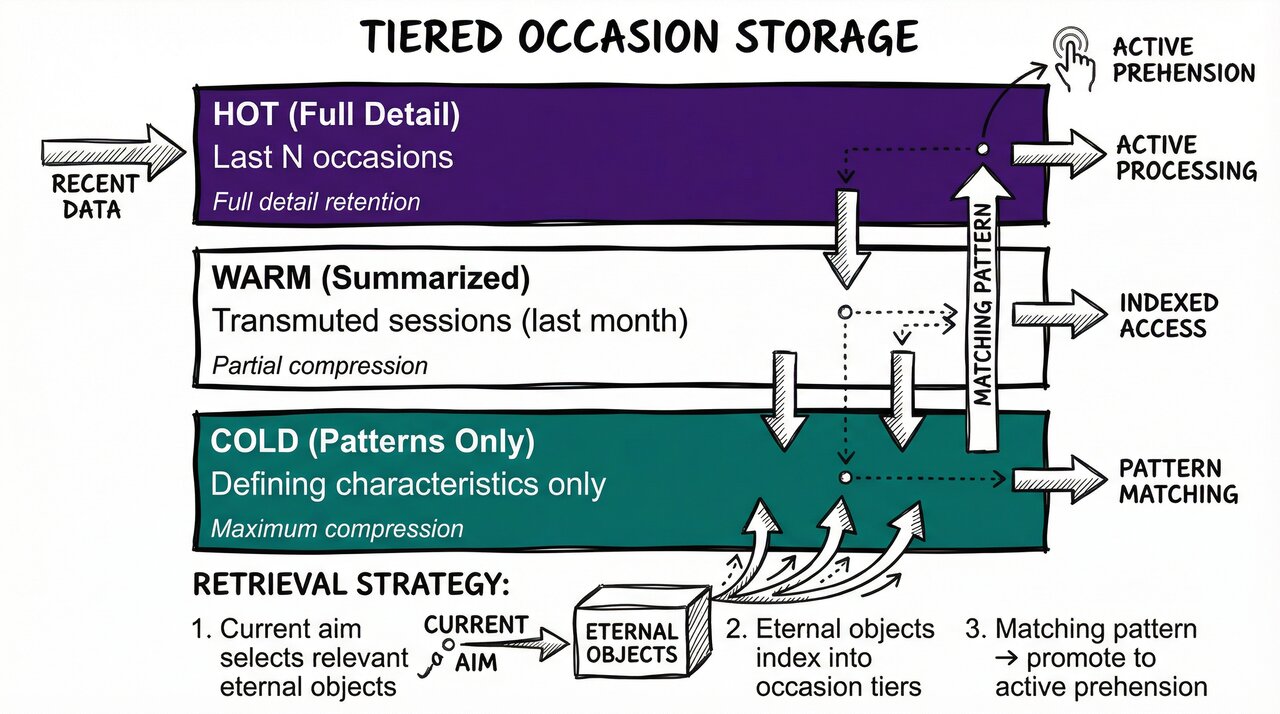
Figure. Tiered Occasion Storage: Hot (recent, full detail) → Warm (summarized sessions) → Cold (defining characteristics only). Retrieval is guided by eternal object matching against the current subjective aim.
What Comes Next
Several directions emerge for future development:
- Formal specification of occasion structures with mathematical precision
- Reference implementation as an open-source library wrapping existing LLM frameworks
- Empirical evaluation comparing process-based agents against baseline architectures
- Extension to multi-agent systems as “societies of societies”
- Integration with neural approaches examining whether attention mechanisms implement something like prehension
A Philosophical Caveat
Before concluding, intellectual honesty requires acknowledging a tension: would Whitehead himself endorse this application of his ideas?
There are reasons for skepticism. For Whitehead, actual occasions are fundamentally experiential, involving genuine subjective feeling rather than merely information processing. He was a panexperientialist who held that experience “goes all the way down” to the most basic constituents of reality [1]. Prehension, in his account, is not data retrieval but feeling, carrying subjective immediacy and qualitative character. Our framework treats prehension as structured context integration, which may constitute a category error from a strict Whiteheadian perspective.
Moreover, Whitehead placed “creativity” as the ultimate metaphysical category, meaning the universe’s capacity for genuine novelty [1]. He might well question whether LLM outputs represent true creativity or sophisticated recombination of training data. And his system assigns God a crucial role in providing the “initial aim” for each occasion, a theological dimension our framework omits entirely.
Yet Whitehead was deeply committed to dialogue between philosophy and science, and he might appreciate the structural move: rejecting substance metaphysics in favor of process-based thinking, treating agents as constituted by their relations rather than as isolated substances, and recognizing that identity is achieved through pattern rather than assumed through configuration.
What we offer, then, is more accurately described as Whitehead-inspired architecture rather than faithful Whiteheadian metaphysics. We borrow his conceptual structures (occasions, prehension, concrescence, satisfaction, eternal objects) as powerful design patterns, while remaining agnostic on his deeper claims about the experiential nature of reality. Whether an LLM-based agent genuinely experiences in Whitehead’s sense is a question we leave open, noting only that the structural parallels yield practical benefits regardless of how that deeper question is ultimately resolved.
Concluding Remarks
The rapid proliferation of LLM-based agents has exposed fundamental limitations in how we conceive agent architecture. Current frameworks, built implicitly on substance metaphysics, treat agents as things that have states, leading to context fragility, identity brittleness, epistemic opacity, and experience dissipation.
We have proposed an alternative: the Whiteheadian Agent Framework, grounded in process philosophy. By reconceiving agents as societies of actual occasions rather than substances with states, we address these limitations at their root.
The framework is not merely philosophical. We have provided TypeScript interfaces, architecture diagrams, and concrete design patterns. We have shown how PAI independently converged on Whiteheadian patterns through engineering optimization, suggesting that process philosophy captures something true about effective agent design.
This is an invitation to think differently about what agents are. Not things that process, but patterns of processing. Not beings, but becomings.
“The many become one, and are increased by one.” — Whitehead, Process and Reality [1]
In each agent occasion, the many inputs become one response. And that response becomes a new datum, increasing the world by one. This is the process view: reality as creative advance, agents as participants in becoming.
References
[1] Whitehead, A.N. (1929). Process and Reality. Macmillan.
- The foundational text of process philosophy that reconceives reality as constituted by events of becoming rather than enduring substances.
[2] Whitehead, A.N. (1925). Science and the Modern World. Macmillan.
- Earlier work establishing the philosophical context for process metaphysics.
[3] Holmes, A. (2015). A History of Philosophy - 61 Whitehead’s Process Philosophy. Wheaton College.
- Accessible introduction to Whitehead’s process philosophy.
[4] Holmes, A. (2015). A History of Philosophy - 62 Whitehead’s Process Theology. Wheaton College.
- Explores theological implications of process philosophy.
[5] Wittgenstein, L. (1921). Tractatus Logico-Philosophicus. Routledge.
- Source of the Sayable/Showable/Silence distinction that grounds our epistemic layer.
[6] Sowa, J.F. (1984). Conceptual Structures: Information Processing in Mind and Machine. Addison-Wesley.
- Foundation for graph-structured knowledge representation in Layer 2.
[7] Gärdenfors, P. (2000). Conceptual Spaces: The Geometry of Thought. MIT Press.
- Geometric approach to conceptual representation enabling similarity and typicality reasoning.
[8] Park, J.S., et al. (2023). Generative Agents: Interactive Simulacra of Human Behavior. UIST.
- Memory-augmented agent architecture that approaches but does not achieve process-based ontology.
[9] Packer, C., et al. (2023). MemGPT: Towards LLMs as Operating Systems. arXiv.
- Explicit memory management for LLM agents; substance-based but sophisticated.
[10] Hickey, R. (2012). The Value of Values. JVM Language Summit.
- Epochal time model and immutable data structures as practical Whiteheadian occasions.
[11] Hewitt, C. (2010). Actor Model of Computation. arXiv.
- Actors as agents of becoming; messages as prehensions in distributed systems.
[12] Varela, F.J., Thompson, E., & Rosch, E. (1991). The Embodied Mind: Cognitive Science and Human Experience. MIT Press.
- Enactivism: cognition as enacted process rather than static representation.
[13] Miessler, D. (2025). Personal AI Infrastructure (PAI). GitHub.
- Reference implementation exhibiting process-like patterns discovered through engineering optimization.
[14] Giarratano, J.C. & Riley, G.D. (2004). Expert Systems: Principles and Programming. Thomson Course Technology.
- Comprehensive treatment of expert systems including forward and backward chaining inference mechanisms.
[15] Hughes, G.E. & Cresswell, M.J. (1996). A New Introduction to Modal Logic. Routledge.
- The standard text on modal logic covering necessity, possibility, and deontic operators.