artwork by Gemini 3 Pro
Generative Ontology: From Game Knowledge to Game Creation
Game Architecture
Part 8 of 10In February 2025, we explored how ontologies reveal the hidden structure of tabletop games. But understanding games is not the same as creating them. What if that same structured knowledge could become a creative engine? This is the promise of Generative Ontology, when knowledge representation learns to imagine.
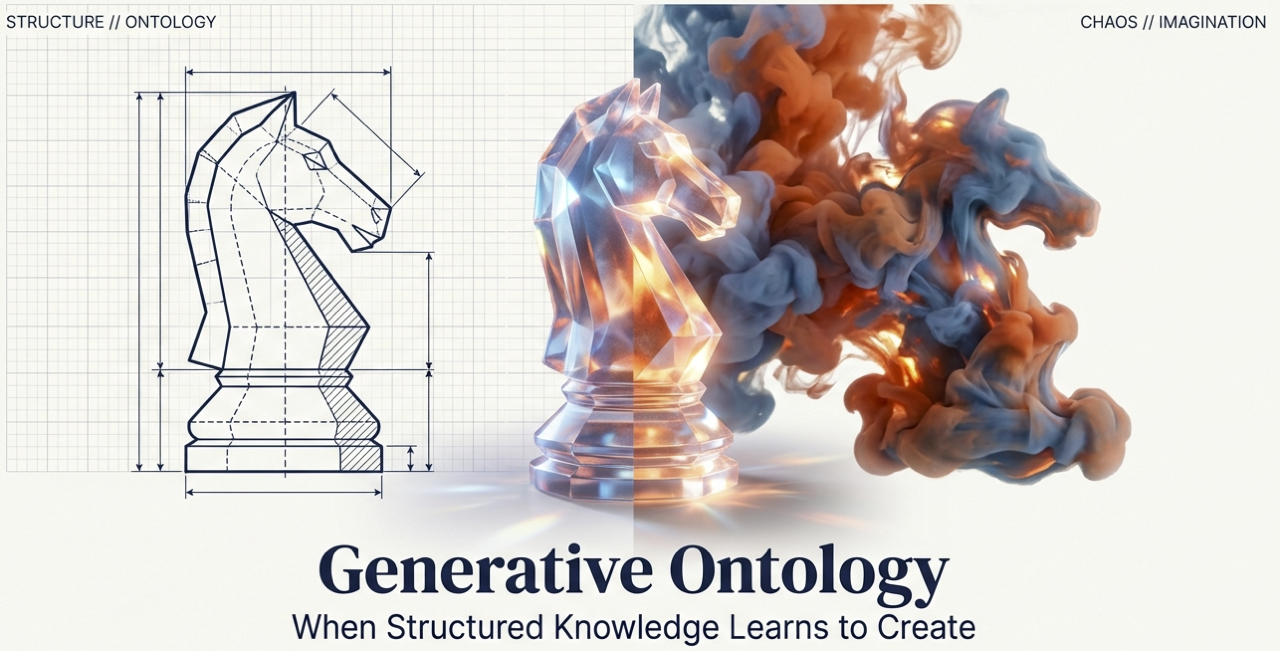
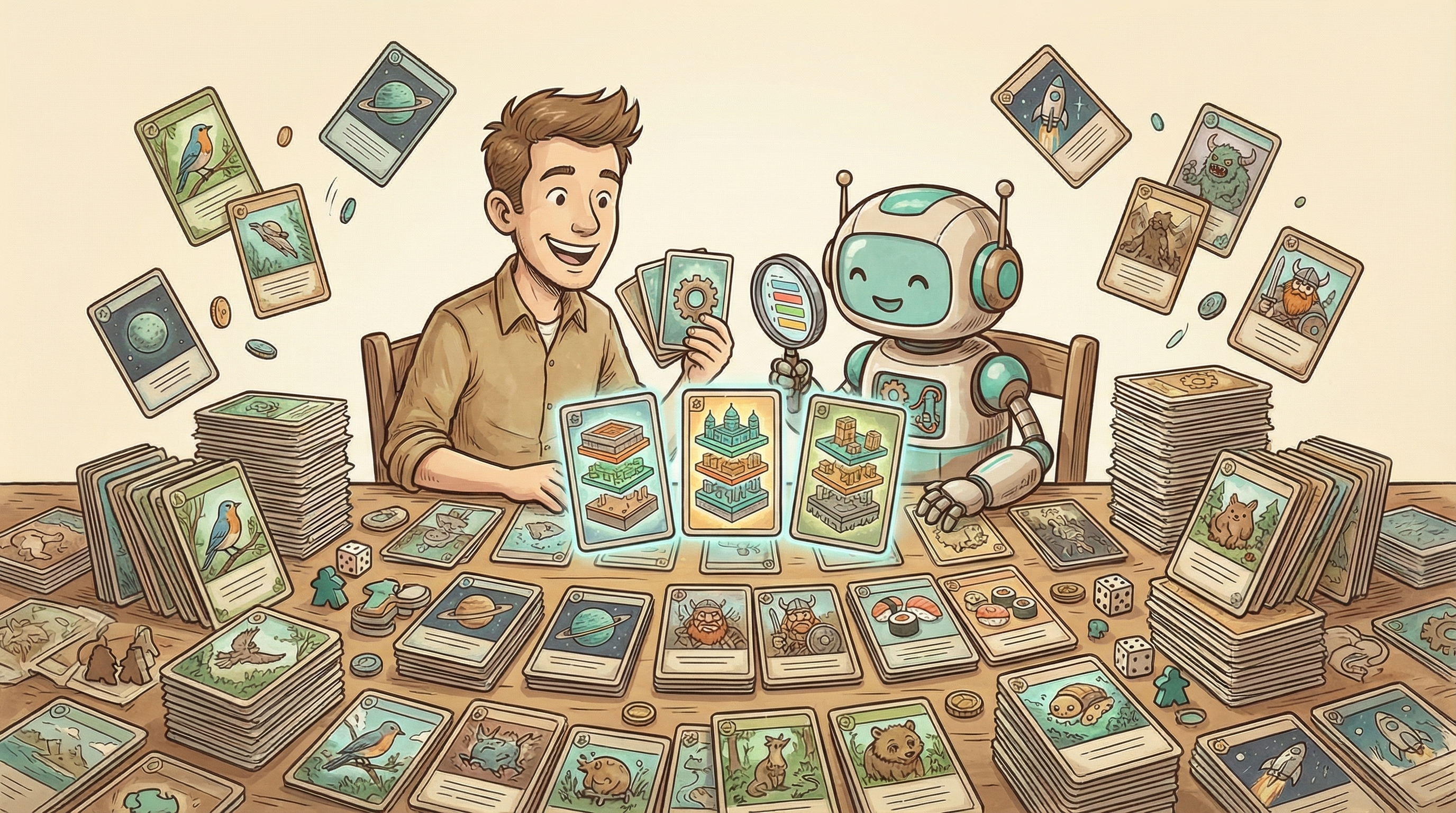
Figure. Structure meets Imagination, the duality at the heart of Generative Ontology.
This article is the conclusion of the Game Architecture series. In Part 4 [8], we built an ontology for tabletop games, decomposing CATAN into mechanisms (resource trading, modular board, dice-driven production), components (hex tiles, resource cards, settlements), and player dynamics (competitive, negotiation-heavy, variable player count). The ontology gave us a vocabulary for understanding games, a precise language for analysis. In Part 5, we demonstrated how that ontology powers a multi-agent generation pipeline. In Part 6, we explored the theory behind structured creative generation. And in Part 7, we showed how a conversational AI partner can learn a designer’s taste.
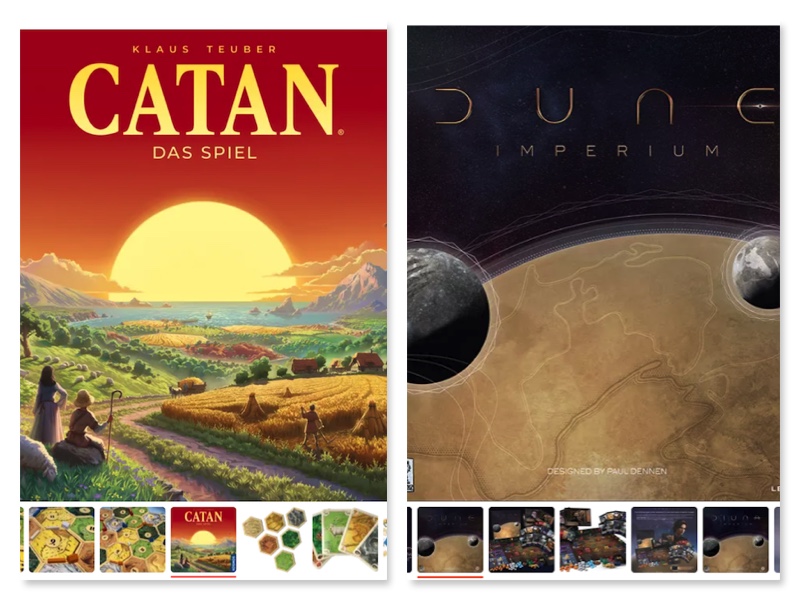
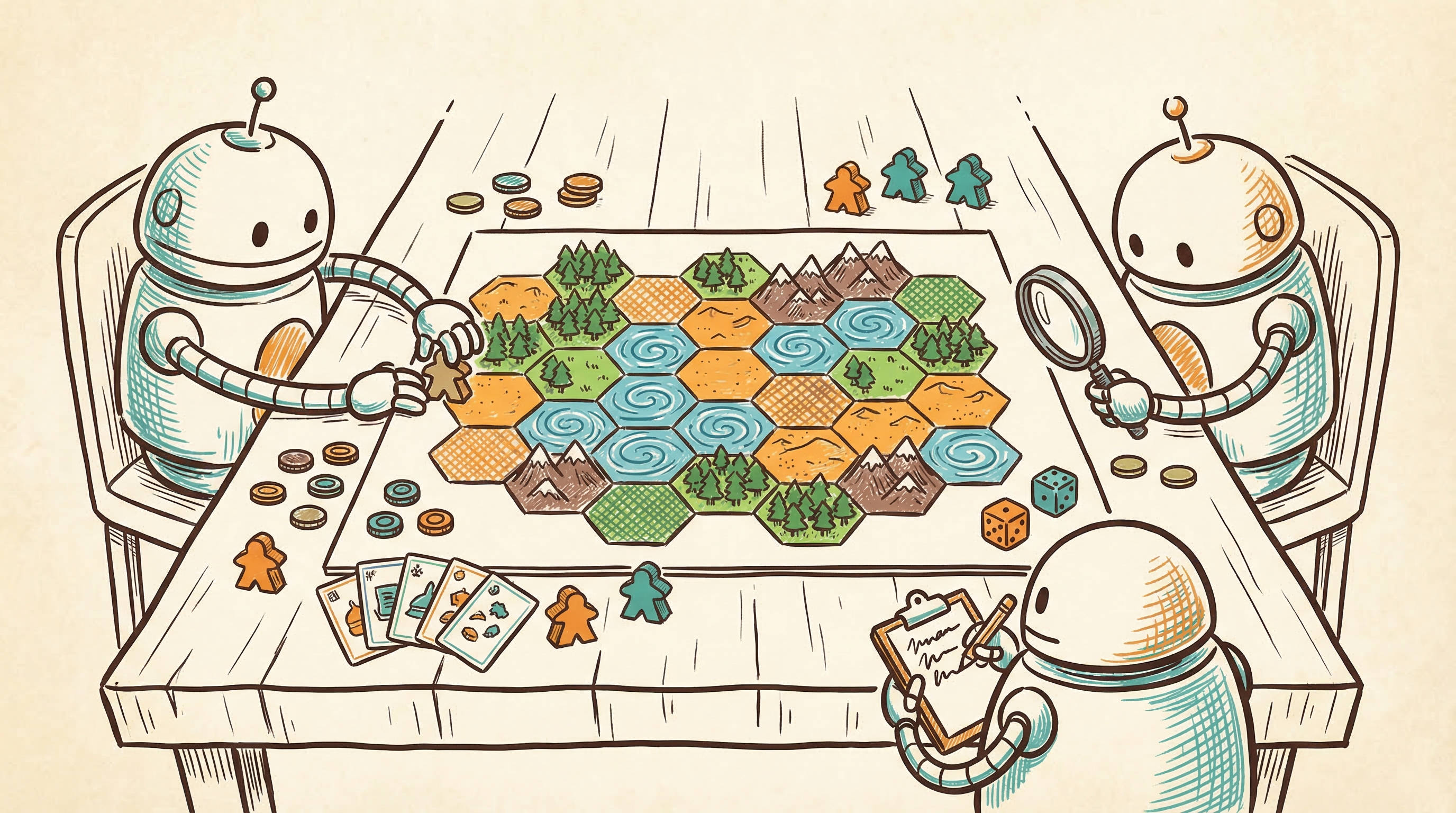
Figure. Games like CATAN and Dune: Imperium share a common ontological structure beneath their vastly different themes.
Now, in this final article, we tackle the question that analysis alone cannot answer: can the same ontology that helps us understand CATAN help us create games that CATAN’s designers never imagined?
We call this synthesis Generative Ontology: the practice of encoding domain knowledge as executable schemas that constrain and guide AI generation, transforming static knowledge representation into a creative engine. This article presents the theoretical framework, walks through a complete game generation from theme to playable design, and provides the experimental evidence that it works.
From Description to Creation
Our game ontology [4] can tell us that worker placement games typically include action spaces, worker tokens, and blocking mechanisms [3]. It cannot generate a novel worker placement game. Large language models have the opposite problem [6]. Ask an LLM to “design a deck-building game set in a haunted mansion,” and it will fluently describe players exploring Ravenshollow Manor, collecting ghost cards, managing a “fear mechanic.” It sounds plausible. But what cards exist in the starting deck? How do players acquire new cards? What triggers the end of the game? The LLM has generated the appearance of a game design without the substance.
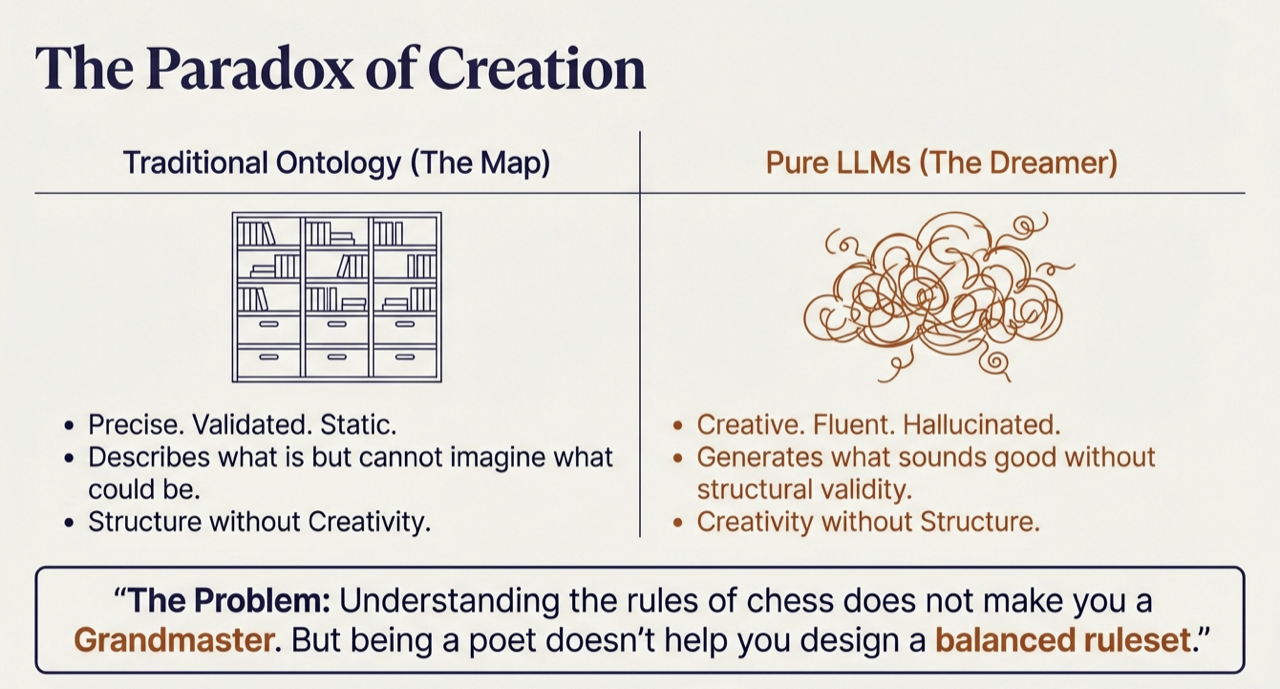
Figure. Traditional Ontology (The Map) vs Pure LLMs (The Dreamer), understanding the rules of chess does not make you a Grandmaster.
| Approach | Strength | Weakness |
|---|---|---|
| Traditional Ontology | Precise, structured, validated | Cannot generate novel outputs |
| Pure LLM Generation | Creative, fluent, abundant | Unstructured, invalid, hallucinated |
These limitations are complementary [5]. What ontology lacks, LLMs provide. What LLMs lack, ontology provides.
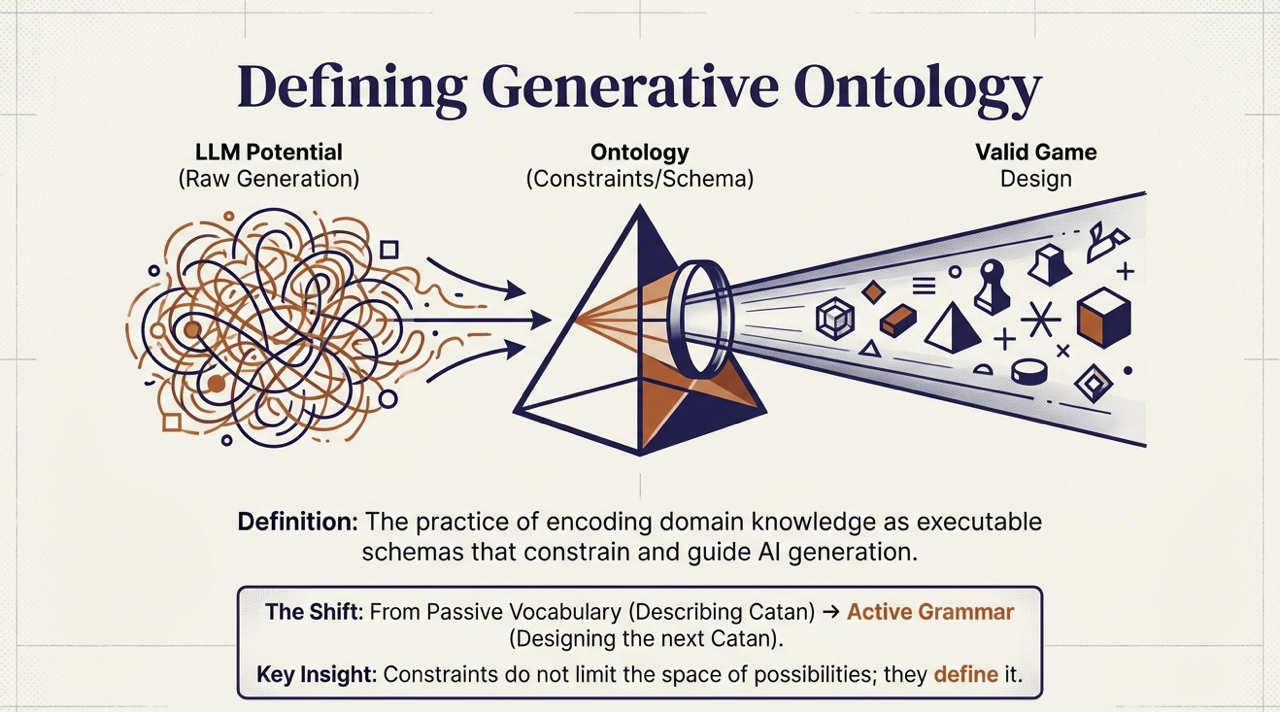
Figure. LLM Potential + Ontology Constraints = Valid Game Design, from passive vocabulary to active grammar.
The Grammar of Games
A poet does not experience grammar as a limitation. Grammar is not what prevents poetry. It is what makes poetry possible. Without syntax, semantics, and form, there would be no sonnets, no haiku, no free verse pushing against convention.
The same principle applies to game design. When we encode our game ontology as a schema, we are not limiting the AI’s creativity. We are giving it the structural vocabulary to be creative coherently. The schema says: every game must have a goal, an end condition, mechanisms that create player choices, components that instantiate those mechanisms. Within those constraints, infinite games are possible. Without them, no valid game emerges.
The grammar does not write the poem. But without grammar, there is no poem to write.
The Whiteheadian Connection
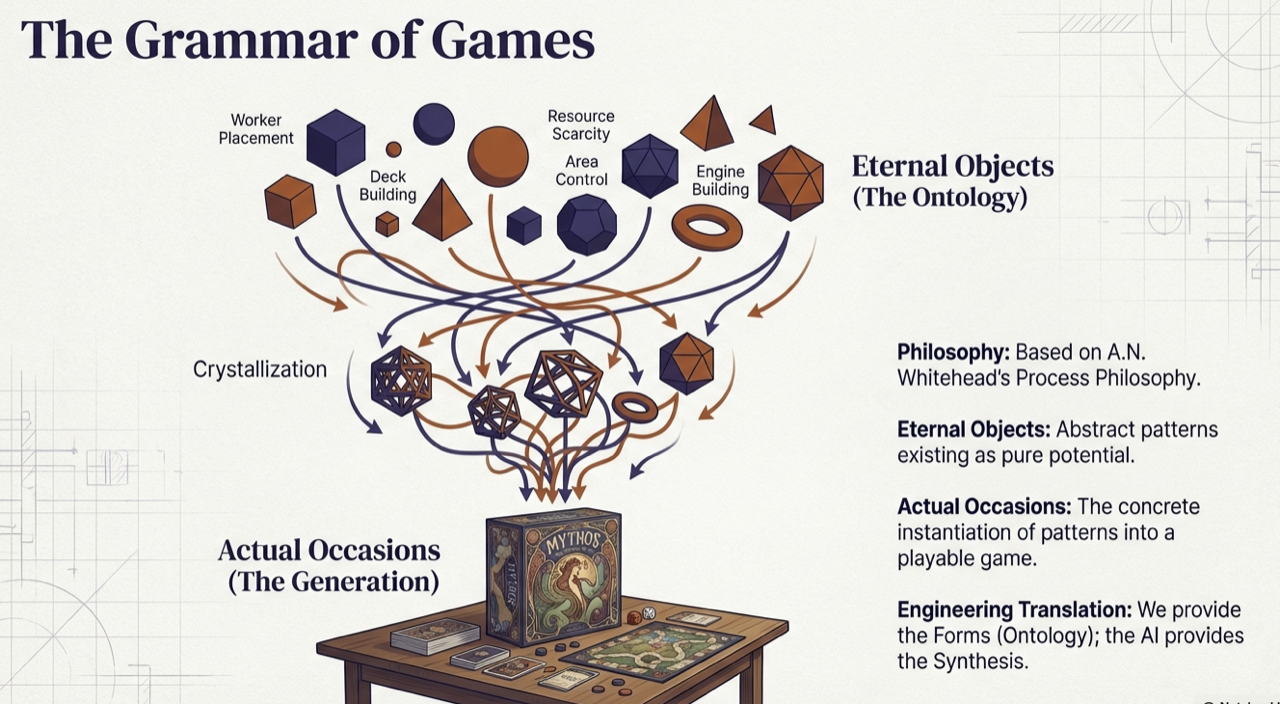
Figure. Eternal Objects (The Ontology) crystallize into Actual Occasions (The Generation), Whitehead’s process philosophy made computational.
In Part 6 and our earlier exploration of Process Philosophy for AI Agent Design [9], we connected Whitehead’s metaphysics to structured generation. Whitehead distinguished between eternal objects (pure forms existing as potentials) and actual occasions (concrete events where forms find expression) [1]. Our game ontology is a collection of eternal objects: the abstract patterns of worker placement, deck building, area control.
What makes this precise is Whitehead’s concept of concrescence: the process by which an actual occasion selects from available eternal objects and synthesizes them into a novel unity [2]. This is exactly what the generation pipeline does. The ontology presents the full space of available patterns. The LLM, constrained by the schema, performs concrescence: selecting from those patterns, combining them with theme, and producing a concrete game that has never existed before. The creativity is real, but it is structured creativity.
From Ontology Classes to Generation Schemas
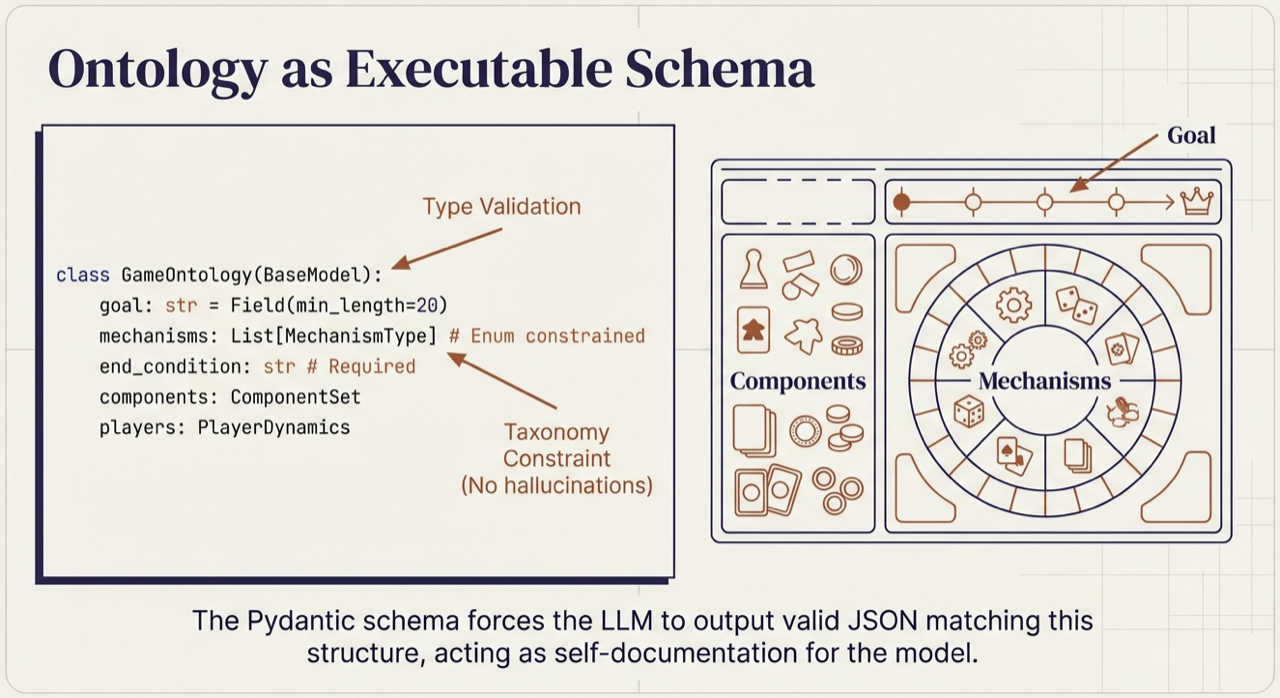
Figure. The schema forces the LLM to output valid structured data matching ontological requirements, acting as self-documentation for the model.
Philosophy illuminates the path; engineering builds the road. The four ontology concepts from Part 4 [8] (Game, Mechanism, Component, Player)map naturally to typed schema definitions:
| Ontology Concept | Schema Role | Purpose |
|---|---|---|
| Game Types | Constrained enumeration | Limits to valid game modes (cooperative, competitive, semi-cooperative) |
| Mechanisms | Typed list from taxonomy | Ensures only recognized mechanics are referenced |
| Components | Structured nested object | Specifies physical game elements with required fields |
| Goal and End Condition | Required string fields with minimum length | Guarantees playability criteria are never left vague |
The schema flips the ontology from a tool for analysis (decomposing CATAN into its parts) into a tool for synthesis. It does not tell the LLM what game to create. It tells the LLM what a game must be to count as valid. But a schema alone is not enough. A single LLM call must simultaneously consider mechanisms, theme, components, balance, and player experience. Human design teams do not work this way.
Specialized Agents for Each Ontology Domain
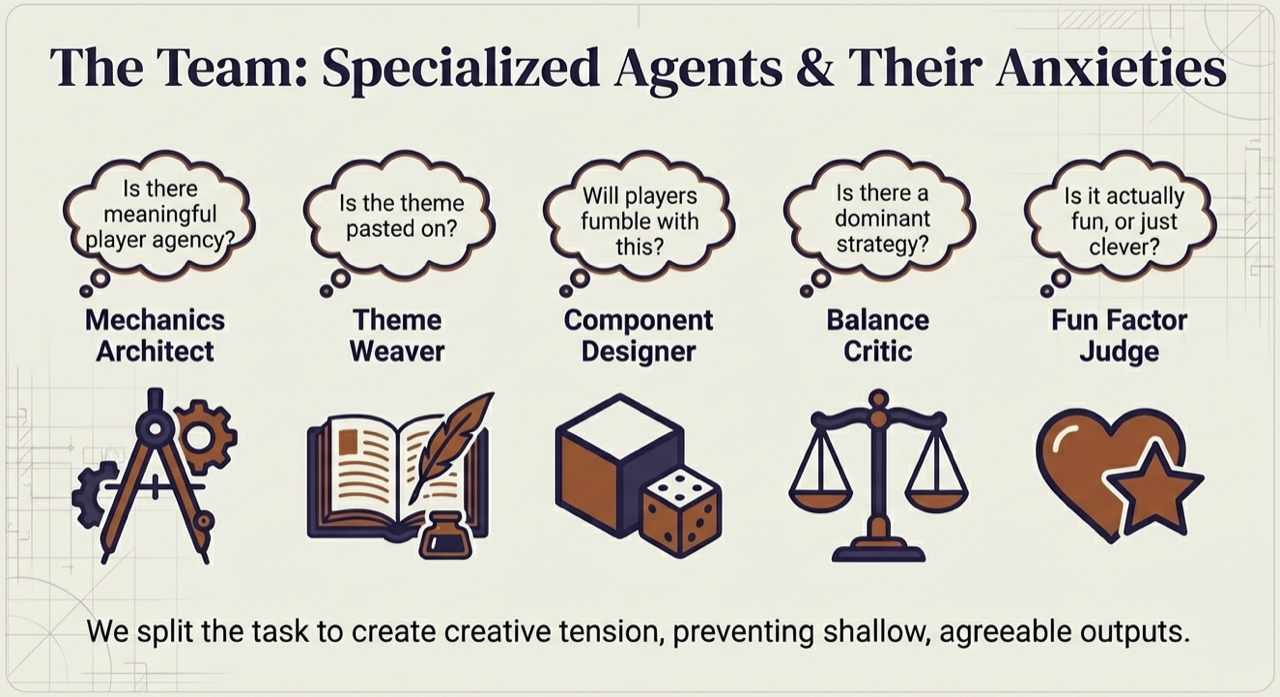
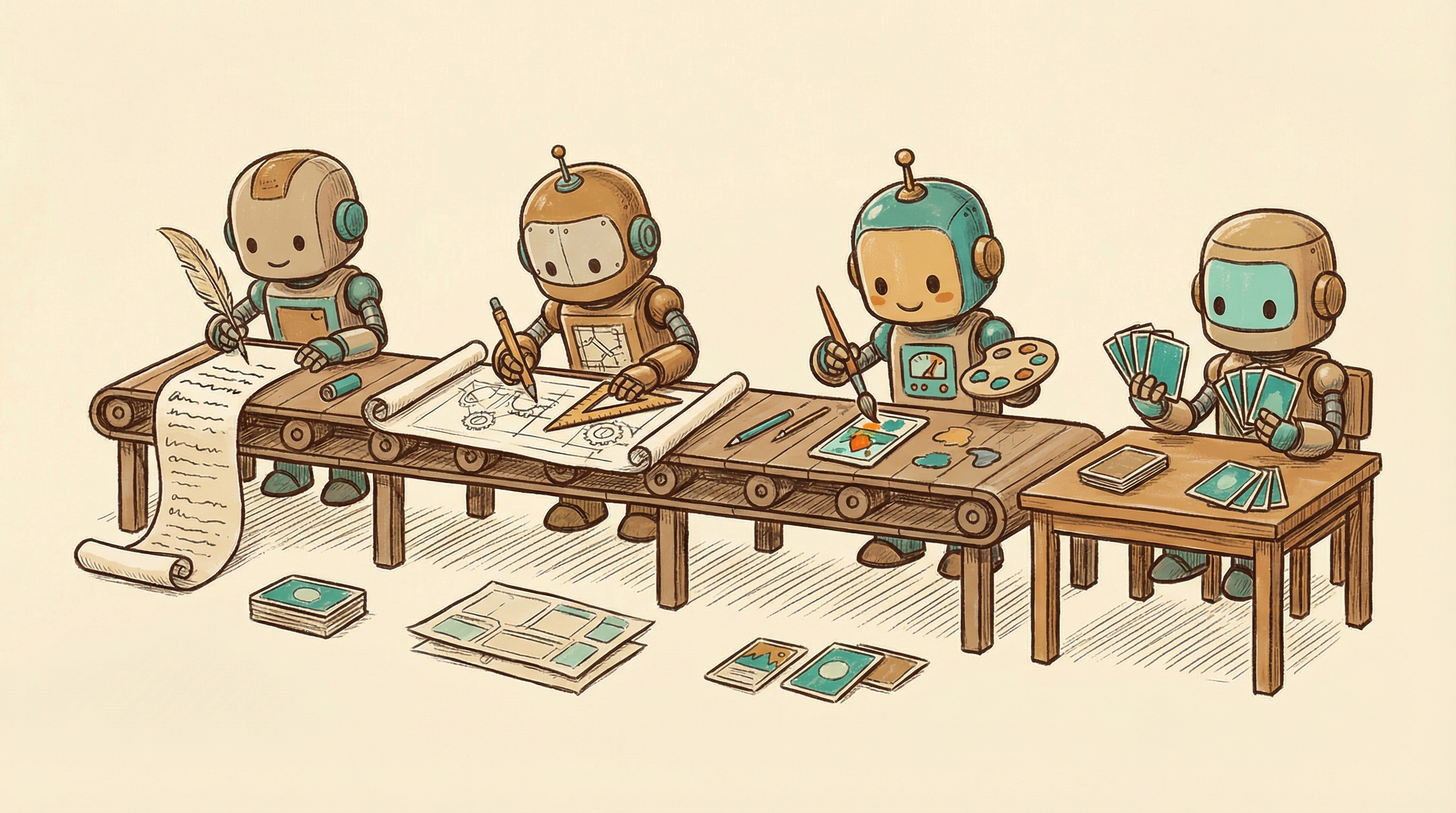
Figure. We split the task to create creative tension, preventing shallow, agreeable outputs.
A game designer sketches mechanics while an artist develops visual language while a playtester identifies broken interactions. Each specialist brings focused expertise.
Generative Ontology enables the same division of labor. As we demonstrated in Part 5, we decompose the ontology into domains and assign specialized agents to each. The result benefits from focused attention at every layer.
The Agent Roster
Our ontology naturally suggests specialization boundaries:
| Agent | Ontology Domain | Expertise | Anxiety |
|---|---|---|---|
| Mechanics Architect | Mechanisms | Turn structure, action economy, resolution systems | “Is there meaningful player agency?” |
| Theme Weaver | Narrative | Setting, flavor, thematic integration | “Does the theme feel alive in every mechanism?” |
| Component Designer | Components | Cards, tokens, board layout, physical affordances | “Can players physically manipulate this smoothly?” |
| Balance Critic | Cross-domain | Interaction analysis, dominant strategy detection | “What breaks? What is unfun when optimized?” |
| Fun Factor Judge | Player experience | Engagement loops, tension, satisfaction | “Would I want to play this again?” |
The “Anxiety” column is the key design innovation. Each agent carries a professional worry that shapes its generation and critique, preventing the “yes-man” tendency of LLMs to produce plausible but shallow output. The Mechanics Architect wants elegant systems; the Fun Factor Judge wants excitement. This built-in tension mirrors real design team dynamics, with information flowing through typed schemas as explicit handoffs.
But collaboration alone does not guarantee correctness. Agents can still agree on outputs that look valid but are not. We need a final layer of assurance.
Validation and Refinement: Ontology as Contract
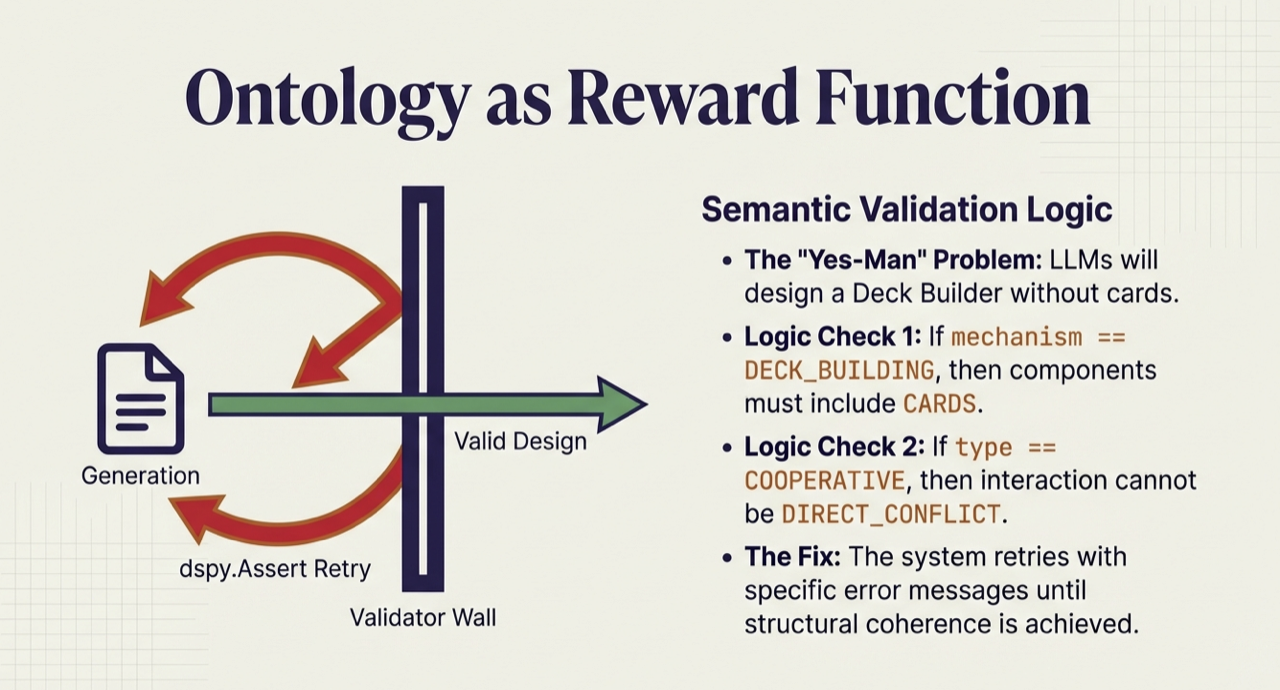
Figure. The system retries with specific error messages until structural coherence is achieved.
Generation is not enough. LLMs are notoriously agreeable. They will produce output that looks valid without ensuring it is valid. Schema validation catches type errors and missing fields, but semantic coherence requires deeper checks. An LLM might declare “deck building” as a mechanism but include no cards in the components. It sounds valid but is structurally incoherent.
Ontological Constraint Checking
We encode cross-field consistency rules that go beyond schema validation:
- Mechanism-Component Coherence: Deck building requires cards. Area control requires a board. Worker placement requires worker tokens. If a mechanism is declared, the corresponding components must exist.
- Game Type Consistency: Cooperative games cannot have direct conflict as their primary interaction mode. Competitive games should not declare cooperative interaction.
- Playability Requirements: Goals must be specific (beyond “win” or “score points”). End conditions, turn structure, and uncertainty sources must all be defined.
The Refinement Loop
When validation fails, the system retries with specific constraint violations as feedback: “deck-building mechanism declared but no cards in components.” This generate-validate-refine loop continues until the design passes all ontological constraints or a maximum number of attempts is reached.
The result is that the ontology functions as a contract. Downstream consumers (human designers, balancing tools, or game engines) can rely on guaranteed structural coherence beyond syntactic validity.
Case Study: A Game of Racing to AGI (Artificial General Intelligence)
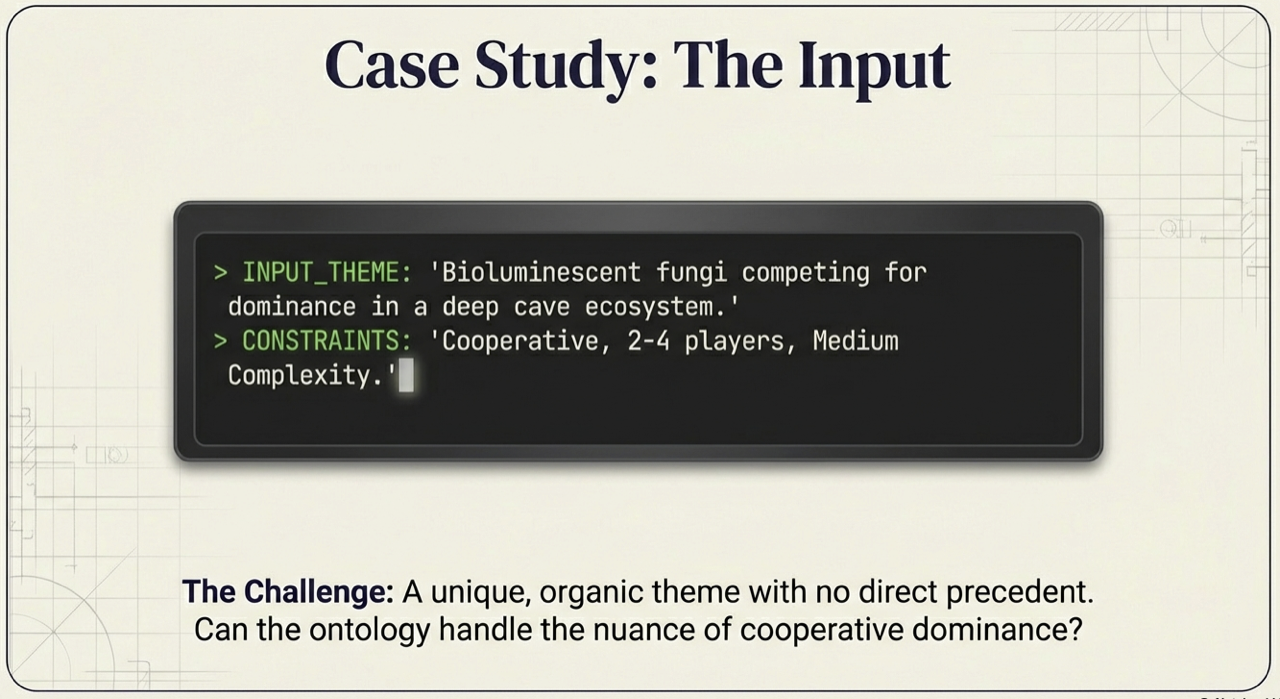
Figure. A timely, high-stakes theme with no direct tabletop analog, can the ontology handle the nuance of competitive strategy with hidden information?
How about a game of AGI? Theory is persuasive; demonstration is convincing. Let us trace a complete generation through our Generative Ontology pipeline, from initial theme to playable game design.
The Input
We provide a theme and constraints:
- Theme: “Rival AI laboratories racing to develop Artificial General Intelligence”
- Constraints: 2-4 players, medium complexity, competitive, 45-60 minutes
This theme was chosen deliberately: it is timely enough to resonate but has no direct tabletop analog, forcing the system to synthesize rather than imitate.
The Design Conversation
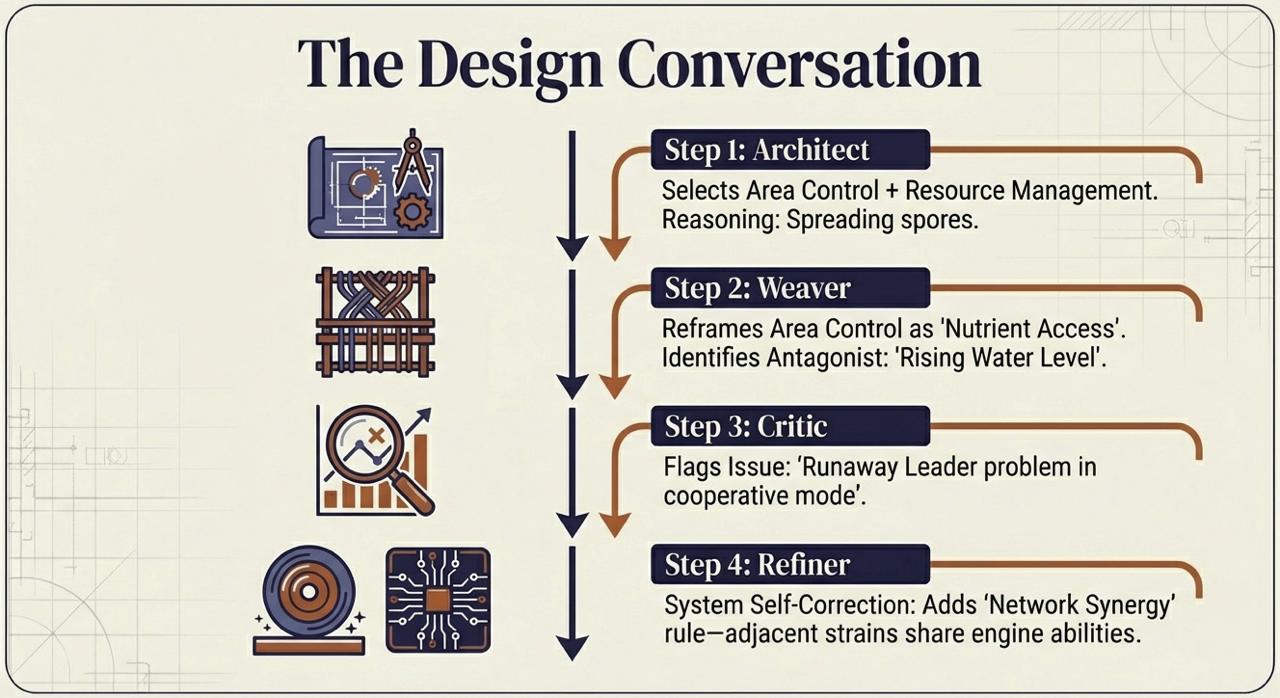
Figure. Step-by-step: Architect to Weaver to Critic to Refiner, system self-correction through specialized agents.
The Mechanics Architect analyzes the theme and identifies that rival AI laboratories suggest parallel development, resource competition, and technological breakthroughs. “Racing to AGI” implies a progress track with a finish line. Given the competitive constraint, players race independently toward a shared victory threshold. It selects action point allocation (secret departmental budgeting), engine building (infrastructure and research synergies), market/auction (competitive talent acquisition), and hidden information (unpublished breakthroughs) as core mechanisms. The turn structure combines simultaneous secret planning with sequential resolution.
The Theme Weaver receives these mechanics and integrates narrative. Action point allocation becomes lab budget decisions across Research, Talent, Infrastructure, and Intelligence departments. Hidden information becomes proprietary research breakthroughs held secret until strategically published. The market becomes a talent war where labs bid for top AI researchers.
Engine building becomes the pursuit of synergistic breakthroughs across five research fields: Neural Networks, Robotics, Quantum Computing, Ethics & Safety, and Hardware.
A 24-card Event deck ensures no two games play out the same, featuring Regulations, Crises, and Breakthroughs that affect all players simultaneously.
The title emerges: Neural Race.
The Component Designer then translates these mechanics into physical form (boards, cards, tokens, and mats), ensuring every mechanism has a tangible instantiation (detailed in the Final Design table below).
The Critic’s Eye
The Balance Critic identifies three issues. First, runaway leader via infrastructure: flat upgrade costs allow leading players to rapidly scale Action Points, creating an insurmountable advantage. Recommendation: cap maximum Action Points at 10 or implement exponentially increasing upgrade costs (3, 5, 8 points). Second, a “rich-get-richer” dynamic in the talent market: reputation bonuses in bidding allow leading labs to acquire the best researchers, cementing their lead. Recommendation: grant bidding bonuses to trailing players or introduce researchers specifically valuable to weaker positions. Third, surprise scoring swings from holding and mass-publishing synergistic breakthroughs. Recommendation: implement stricter hand size limits or mechanics that force partial information reveals.
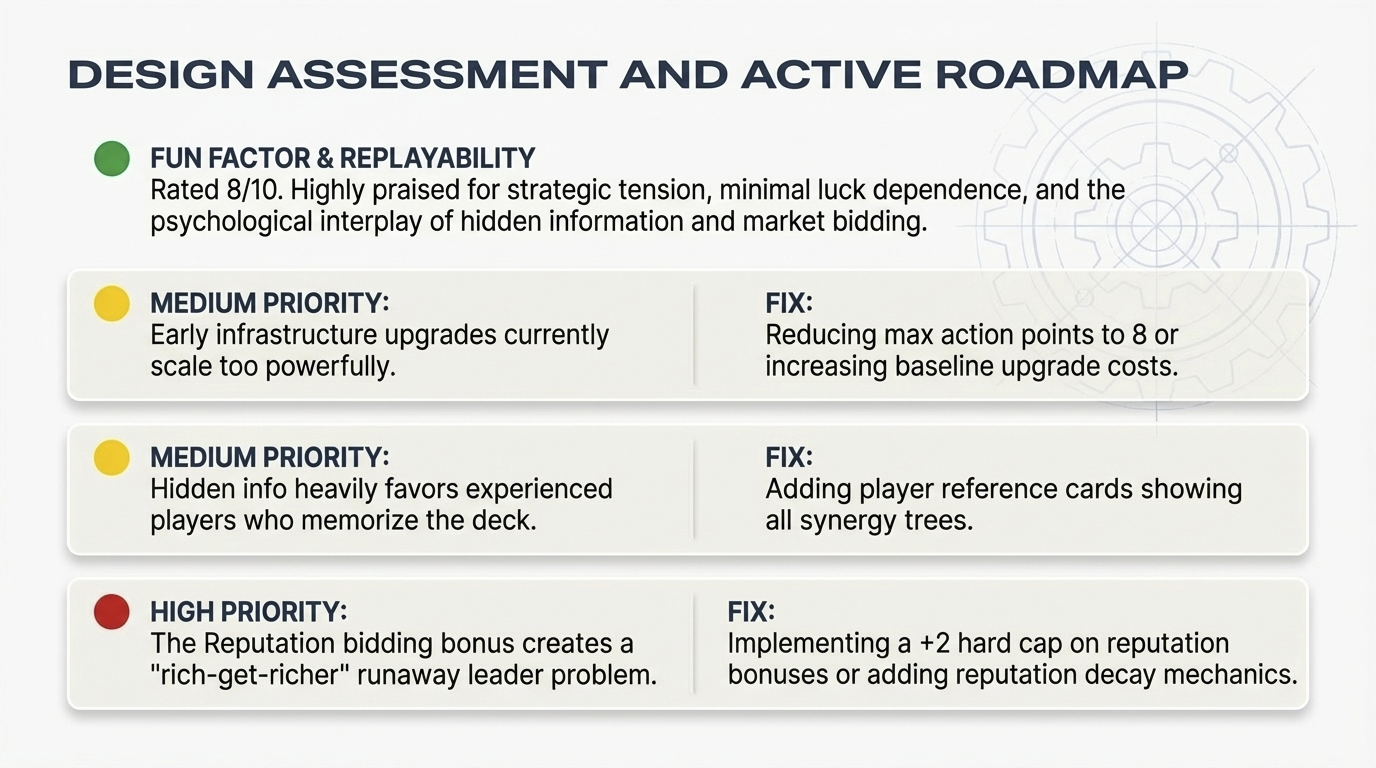
Figure. The design assessment with an active roadmap of prioritized fixes.
The refinement agent addresses the high-priority reputation issue with a +2 hard cap on bidding bonuses and reputation decay mechanics. The moderate-priority items (infrastructure scaling and hidden information asymmetry) receive targeted fixes: reducing max action points to 8, and adding player reference cards showing all synergy trees. The Fun Factor Judge evaluates the refined design at 8/10. Key engagement hooks: the race dynamic as players approach the AGI victory threshold, the uncertainty of opponents’ hidden breakthrough cards, and the risk/reward calculation of when to publish.
The Final Design
Figure. Neural Race at a glance: five phases of gameplay from secret planning through progress evaluation, with synergy bonuses rewarding deep research investment.
The complete output:
| Field | Value |
|---|---|
| Title | Neural Race |
| Theme | Rival AI laboratories racing to develop AGI in a high-stakes global competition |
| Game Type | Competitive |
| Goal | Advance on the AGI Progress Track by publishing research breakthroughs; first to 20 progress points wins |
| End Condition | Sprint: First player to 20+ AGI progress triggers immediate victory. Endurance: If no player reaches threshold, highest total of AGI progress + synergy bonuses + reputation wins. |
| Mechanisms | Action Point Allocation, Engine Building, Market/Auction, Hidden Information |
| Turn Structure | 1) Secret allocation of Action Points to departments, 2) Research execution and breakthrough draws, 3) Talent market bidding, 4) External event, 5) Progress evaluation |
| Player Count | 2-4 |
| Interactions | Competitive bidding, hidden breakthroughs, reputation race, variable lab specializations |
| Core Loop | Plan (allocate), Research (draw), Market (bid), Event (adapt), Evaluate (score), Repeat |
Every mechanism maps to a thematic action. Every component serves a mechanical purpose. The full component specification, from the 60-card Research Breakthrough deck to the custom wooden robot meeples, is detailed in the interactive ontology on GameGrammar [11].
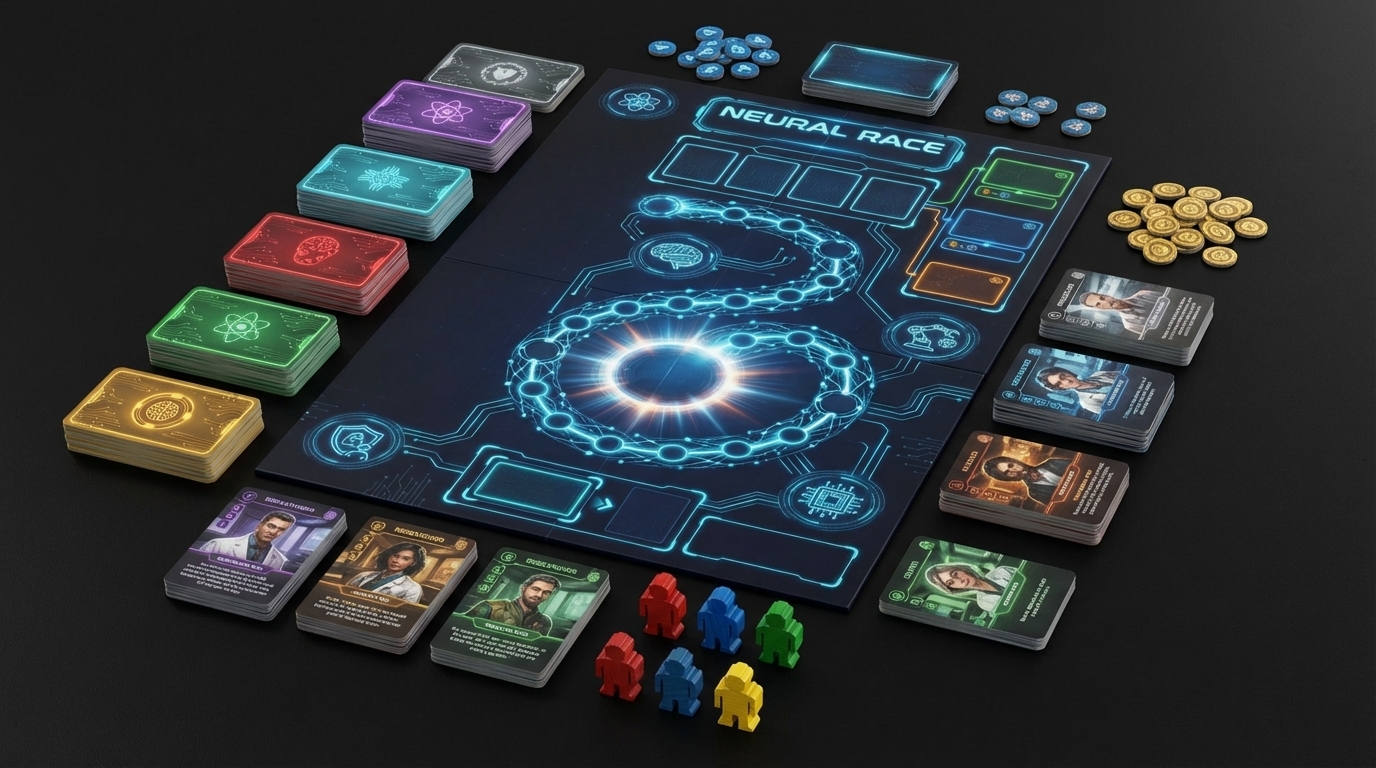
Figure. An imagined physical realization of Neural Race, where the AGI Progress Track spirals toward the center, flanked by color-coded research decks, researcher specialists, and custom robot meeples.
What Does It Feel Like to Play?
Numbers and tables describe the design. But does it feel like a game? Consider Turn 5: Sarah trails Tom 12 to 14 on the AGI track. Tom has been aggressively acquiring talent. Sarah allocates 4 AP to Research and draws Recursive Neural Architecture Search. Combined with her two hidden cards, she now holds a devastating 9 AGI Progress combo. The Talent Market reveals Dr. Martinez, a crucial quantum specialist. Sarah bids 4 (3 AP + 1 Reputation). Tom shocks the table by bidding 6 Talent Points, desperate to block her quantum advantage. Sarah is forced to pivot to Dr. Liu instead.
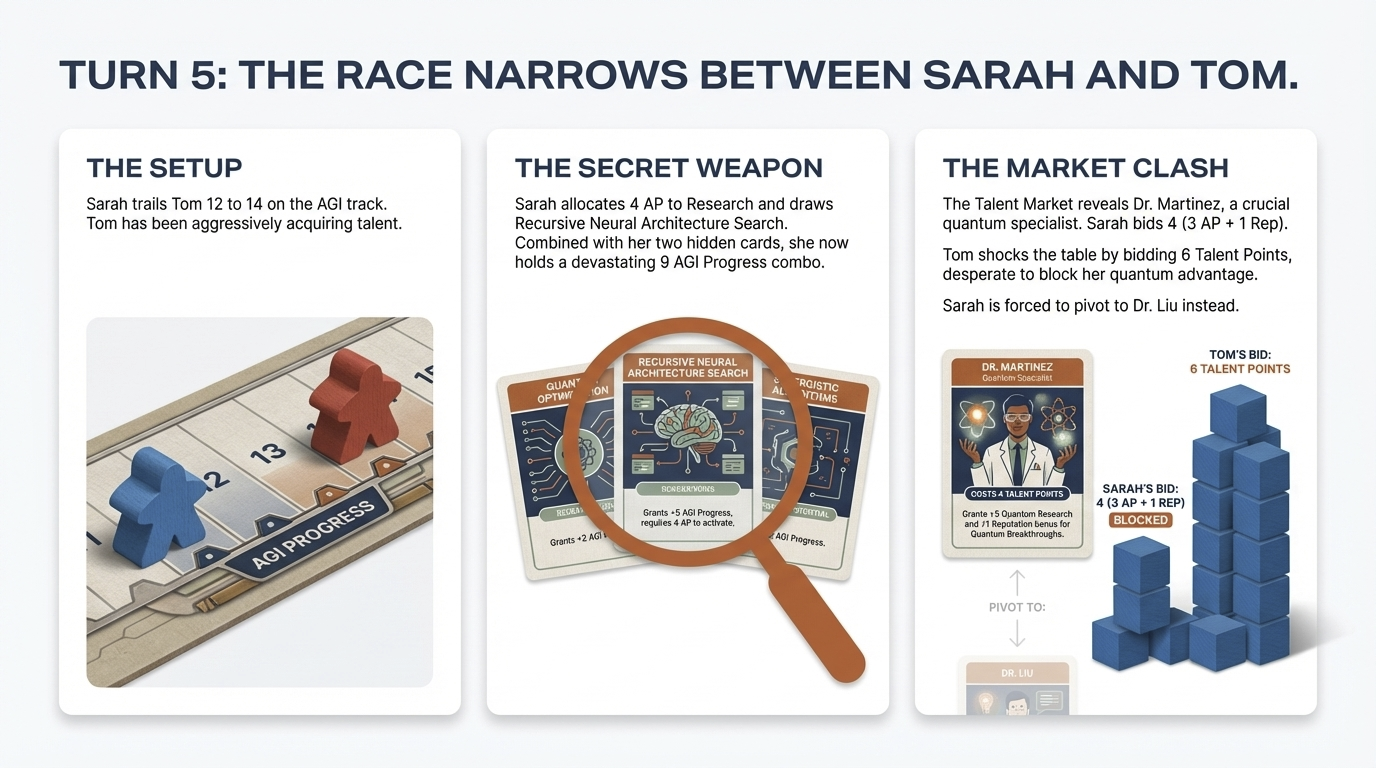
Figure. A concrete play moment showing the interplay between planning, card draws, and market competition. Every card cost, synergy reference, and bidding value was validated by the ontology before generation completed.
Despite losing the market clash, Sarah’s hidden combo remains intact. This moment captures the publish-or-hoard dilemma at the heart of Neural Race: hold your breakthroughs to build a massive chain, or publish early to bank points and reputation before an opponent disrupts your plan. The ontology guaranteed that the synergy references are valid, that the costs balance against the payoff, and that the card interactions are internally consistent. What it cannot guarantee is whether that moment feels triumphant or cheap. That judgment belongs to the human designer.
What Generative Ontology Provided
Without the ontology schema, an LLM generating “a competitive game about rival AI labs” would likely produce vague victory conditions (“be the first to develop AGI somehow”), inconsistent mechanisms (mentioning an auction but specifying no bidding currency), missing components (no actual game pieces defined), and disconnected theme (mechanics unrelated to research or competition).
The Generative Ontology framework ensured:
| Requirement | How It Was Enforced |
|---|---|
| Complete goal specification | Minimum length constraint on goal field |
| Coherent mechanism-component alignment | Validation function checked that declared mechanisms have matching components |
| Thematic integration | Theme Weaver agent explicitly connected every mechanism to the narrative |
| Playability basics | Required fields for turn structure, uncertainty source, end condition |
| Balance review | Balance Critic agent with “break this” professional anxiety |
The output is playable. A designer could take this output, build a prototype, and begin playtesting. The ontology grammar guaranteed that all the essential elements of a game are present and coherent.
But a single compelling example does not prove that the framework works in general. Does Generative Ontology reliably produce better designs than unconstrained LLM generation?
Does It Work? The Evidence
In our formal study [12], we conducted three experiments to measure whether Generative Ontology reliably improves AI-generated game designs.
Study 1: Ablation. What Does Each Layer Contribute?
We generated 120 game designs across four conditions, progressively adding layers of the Generative Ontology framework:
| Condition | Configuration | Structural Errors | Creative Quality |
|---|---|---|---|
| C1 Baseline | Raw LLM, no schema | 5.03 errors/design | Low (fun: baseline) |
| C2 Schema | Pydantic validation only | 0.10 errors/design | Low |
| C3 Ontology | Schema + ontology, single agent | 0.00 errors | Moderate |
| C4 Pipeline | Full: schema + ontology + multi-agent | 0.00 errors | High |
The results are stark. Schema validation alone eliminates nearly all structural errors (Cohen’s d = 4.78). But structural validity does not guarantee creative quality. The leap from C3 to C4, adding the multi-agent pipeline with specialized anxieties, is where creative quality emerges:
- Fun rating: d = 1.12 (p < .001)
- Strategic depth: d = 1.59 (p < .001)
- Elegance: d = 1.14 (p < .001)
- Tension and drama: d = 0.79 (p < .05)
In plain terms: the ontology provides structural validity; the multi-agent pipeline provides creative quality. Neither alone suffices. The framework needs both layers.
Study 2: Benchmark. How Close to Published Games?
We then compared 30 pipeline-generated designs against 20 published board games (CATAN, Dune: Imperium, Wingspan, and others), evaluated across the same creative dimensions:
| Dimension | Published Games | Generated Designs | Gap |
|---|---|---|---|
| Fun Rating | 8.9 | 8.1 | Moderate |
| Strategic Depth | 8.9 | 8.1 | Moderate |
| Tension & Drama | 8.5 | 8.2 | Near parity |
| Social Interaction | 7.2 | 6.9 | Near parity |
| Elegance | 9.3 | 8.0 | Notable |
| Replayability | 9.1 | 7.6 | Notable |
Generated designs consistently score in the 7-8 range (good, playable first drafts) while published games score 8-9 (polished, playtested products). The gap is real but expected: published games have undergone months or years of human iteration. What matters is that the generated designs achieve near-parity on tension/drama and social interaction, the experiential qualities that make games feel engaging.
One surprising finding: generated designs had fewer structural consistency errors (1.27) than published games (2.80, d = 0.76). The ontology enforces a level of internal coherence that even professional designers sometimes overlook.
The Constraint Paradox
The ablation results reveal something counterintuitive. Adding constraints alone (C2, C3) eliminates structural errors without improving creative quality. Constraints actually suppress richness when applied to a single agent. But the combination of constraints with architectural specialization (C4) produces the largest creative gains. This is what we call the Constraint-Architecture Interaction Model: creative quality is a function of constraint expressiveness multiplied by architectural specialization. Constraints set the floor. Specialization raises the ceiling. Neither alone suffices.
The Gap as Feature
The one-point creative gap between generated and published designs is, paradoxically, encouraging. Published games represent years of iterative playtesting, community feedback, and designer refinement. No single generation pass can replicate that process. That the pipeline produces designs in the 7-8 range (“good, playable, interesting first drafts”) rather than the 8-9 range (“polished, elegant, replayable”) suggests the gap reflects not a fundamental limitation of the approach but the absence of iterative refinement. The dimensions where parity is already achieved (tension/drama and social interaction) may be those most amenable to specification-time design. The gap dimensions (elegance and replayability) likely require iterative playtesting to optimize.
A separate test-retest reliability study (ICC analysis across 50 evaluations) validated the LLM-based evaluator itself, with 7 of 9 creative metrics achieving Good-to-Excellent reliability (ICC 0.836-0.989). The evaluation method is trustworthy, which means the gap measurement is trustworthy.
What the Evidence Tells Us
The experiments confirm the core thesis: structure enables creativity. Raw LLMs produce fluent but structurally broken output. Schema validation fixes structure but not quality. The full Generative Ontology pipeline, with ontology constraints, multi-agent specialization, and validation loops, produces designs that are both structurally sound and creatively engaging. The formal treatment with full statistical analysis is available in our paper [12].
Beyond Games: Generative Ontology as a General Framework
The tabletop game domain was our proving ground, but the pattern is not specific to games. Generative Ontology applies wherever three conditions hold:
- The domain has established structure. There exists a vocabulary of types, relationships, and constraints that experts use to reason about the domain.
- Valid outputs must satisfy cross-field constraints. Correctness requires relationships between fields to be coherent, beyond individual fields being well-formed.
- Creative generation within structure has value. The goal is production of novel outputs that conform to domain rules.
Medical summaries require that diagnoses align with reported symptoms and prescribed treatments [5]. Legal contracts require that defined terms appear in operative clauses. Software architectures require that declared interfaces match their implementations. Recipe generation requires that ingredient quantities yield a dish that actually works.
In each case, an unconstrained LLM produces fluent output that may violate domain constraints. And in each case, an ontology, encoded as executable schema, can provide the grammar that makes valid generation possible. The multi-agent pattern extends naturally: a medical ontology might decompose into diagnostic, treatment, and contraindication agents with their own professional anxieties.
The insight is general: domain ontologies are grammars for creation. Any domain with sufficient structure can be made generative.
Concluding Remarks
Across this series, we have traced an arc: from analyzing games (Part 4) to generating them (Part 5) to understanding why structured generation works (Part 6) to collaborating with designers in real time (Part 7). This final article has provided the theoretical synthesis and the empirical evidence.
In Whitehead’s terms [1], we have given eternal objects, the abstract patterns of game design, a computational mechanism for concrescence, the synthesis of familiar forms into novel actualities [2]. Generative Ontology is creative advance made operational.
When this paper was first published, two questions remained open: could a conversational AI partner iterate on generated designs with a human designer? And could generated designs be playtested automatically?
Both have since been answered. Nova (Part 7) is a conversational AI co-designer that reads the full game ontology, remembers every design decision across sessions, and proposes changes with before-and-after comparisons. An automated playtesting engine simulates games using Monte Carlo Tree Search agents and LLM-based player archetypes, surfacing balance issues, degenerate strategies, and scoring gaps before a single prototype is printed. The iterative refinement loop that the paper identified as the likely source of the creative gap is now partially closed.
Deeper questions remain. Can AI systems induce ontologies from corpora of successful examples, learning generative grammars from exemplars rather than encoding them by hand? Can the creative gap be fully closed through automated iteration, or does the final mile always require human taste? These are open research questions. But the foundation is established: structured knowledge, made alive, enables structured creation.
The grammar does not write the poem. But without grammar, there is no poem to write. And now, we have evidence that the grammar works.
- Unlocking the Secrets of Tabletop Games Ontology (Part 4)
- Introducing GameGrammar: AI-Powered Board Game Design (Part 5)
- GameGrammar: The Theory of Generative Board Game Design (Part 6)
- Nova: The AI Co-Designer That Learns Your Taste (Part 7)
- » Generative Ontology: From Game Knowledge to Game Creation (Part 8)
References
[1] Alfred North Whitehead. Process and Reality. Free Press, 1929/1978.
- Foundation for the eternal objects / actual occasions framework
[2] Timothy Barker. Artificial Creativity: A Process Philosophy of Technology Perspective. Journal of Continental Philosophy, 2024.
- Connects Whitehead’s process philosophy to generative AI creativity
[3] Geoffrey Engelstein and Isaac Shalev. Building Blocks of Tabletop Game Design: An Encyclopedia of Mechanisms. CRC Press, 2020.
- The comprehensive taxonomy underlying our game ontology
[4] Natalya F. Noy and Deborah L. McGuinness. Ontology Development 101. Stanford University.
- Foundation for ontology design principles
[5] Jorge Martínez-Gil, et al. Ontology-Constrained Generation of Domain-Specific Clinical Summaries. arXiv:2411.15666, Nov 2024.
- Closest methodological precedent using ontology-guided constrained generation
[6] Roberto Gallotta, et al. Large Language Models and Games: A Survey and Roadmap. arXiv:2402.18659, Feb 2024.
- Comprehensive survey of LLM applications in games
[7] Matthew Guzdial, et al. Boardwalk: Towards a Framework for Creating Board Games with LLMs. arXiv:2508.16447, 2025.
- Board game code generation from rules (contrasts with our design generation approach)
[8] Benny Cheung. Unlocking the Secrets of Tabletop Games Ontology. Feb 2025.
- Part 4 of the Game Architecture series, foundation for this post
[9] Benny Cheung. Process Philosophy for AI Agent Design. Jan 2026.
- Whiteheadian framework connecting to creative advance
[10] GameGrammar. Dynamind Research, 2026.
- AI-powered tabletop game design platform built on Generative Ontology
[11] Neural Race on GameGrammar. Dynamind Research, 2026.
- Interactive display of the complete generated game ontology from the case study in this article
[12] Benny Cheung. Generative Ontology: When Structured Knowledge Learns to Create. arXiv:2602.05636, Feb 2026.
- Formal paper with ablation study (120 designs), benchmark comparison, and evaluator reliability analysis