
Key Themes and Insights from Benny’s Mind Hack
The Benny’s Mind Hack represents a multi-year exploration into the intersection of artificial intelligence, software architecture, and human creativity. The author examines technical advancements in generative AI and large language models, offering practical guides on everything from song composition to reducing operational costs. Beyond modern trends, the blog features deep dives into spatial reasoning, logic programming, and blockchain technology applied to healthcare and security. Entries also touch upon the philosophical implications of technology, pondering how automated intelligence influences our sense of identity and purpose. Ultimately, the source serves as a personal archive of experimental engineering and computational problem-solving.
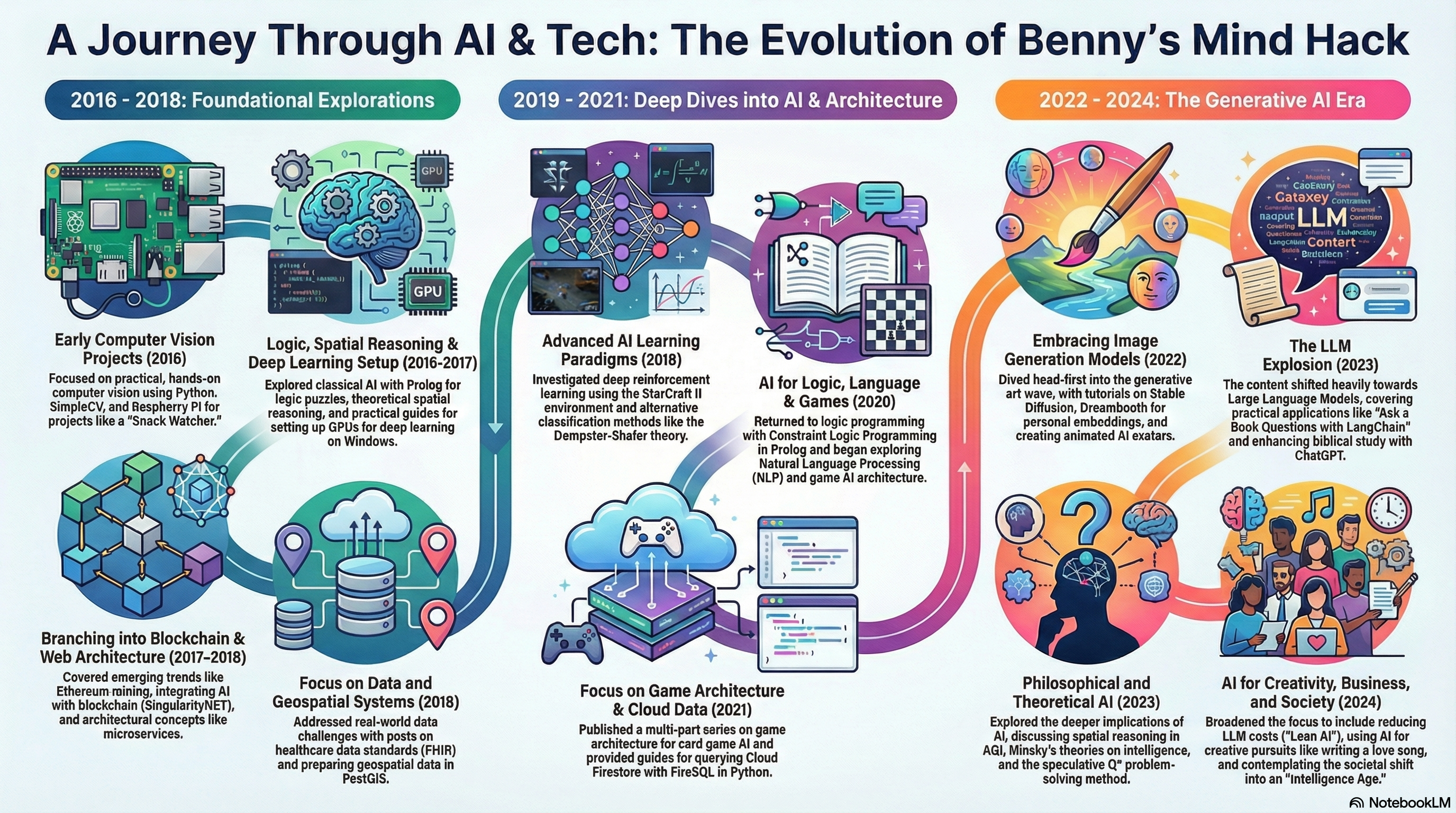
Dominant Focus on Artificial Intelligence
Artificial Intelligence is the central and most extensively covered subject, with explorations spanning its history, modern applications, and future potential. The posts cover a wide spectrum, from deep technical tutorials to philosophical discussions on the nature of intelligence.
Generative AI and Large Language Models (LLMs)
A significant portion of recent content focuses on the blooming field of Generative AI and LLMs, highlighting both creative and practical use cases.
- Practical Applications: The blog details projects using AI for creative endeavors, such as generating a love song by combining AI tools with poetry (August 2024), and for knowledge work, such as enhancing Biblical study with ChatGPT (March 2023) and creating systems to ask questions of a book using LangChain and OpenAI (February 2023).
- Business and Cost Management: A post on “Lean AI” (December 2023) addresses the critical business question of how to manage and reduce the costs associated with LLMs to ensure the success of GenAI startups.
- Developer Tools: The Dify platform is highlighted as a tool for practical, hands-on learning in the GenAI space, contrasting it with purely theoretical knowledge acquisition (May 2024).
Deep Learning and Computer Vision
The blog documents a long-standing interest in deep learning, particularly in the domain of computer vision, often involving personal and experimental projects.
- Model Training and Personalization: Several posts detail the process of training models for personal use, such as using Stable Diffusion and Dreambooth for creating personalized embeddings and art (April 2022, November 2022). This follows earlier explorations of Neural Style Transfer and Deep Dream (February 2017).
- Real-World Applications: Projects demonstrate the use of computer vision for real-time object detection, such as a system for identifying food using YOLO (April 2018) and a “Snack Watcher” project using a Raspberry Pi to monitor and classify snacks (April 2016).
- Hardware and Infrastructure: The technical requirements for deep learning are addressed, with guides on leveraging GPUs on Windows 10 for serious computation (July 2016).
AI Theory and Philosophy
Beyond practical implementation, the content delves into the theoretical and philosophical dimensions of AI, contemplating its nature and future trajectory.
- The Nature of Intelligence: One post explores the idea of AI as an evolving “being” rather than a mere tool, referencing a 1985 article by Marvin Minsky on universal intelligence (November 2023).
- Problem-Solving Frameworks: A speculative proposal named Q* (“Q-star”) is explored as a conceptual framework for problem-solving, imagined to exist at the intersection of the A* algorithm and Q-learning (November 2023).
- Societal Impact: A recent article discusses the “Intelligence Age,” examining the existential questions and challenges humans face as AI becomes more prevalent (September 2024).
AI in Gaming
A multi-part series is dedicated to the architecture of AI for complex card games, using “Race for the Galaxy” as a case study.
- Architectural Breakdown: The series deconstructs the software architecture required for a card game, covering the model, game engine, and game interface (September 2020, June 2021).
- Advanced AI Techniques: The final part focuses specifically on the game’s AI, noting its use of neural networks and reinforcement learning as early as 2009, predating well-known systems like AlphaGo (June 2021).
Specialized Interest in Spatial Reasoning
A distinct and consistent theme is the exploration of spatial reasoning, tackled from philosophical, theoretical, and applied technological perspectives. This demonstrates a specialized area of expertise that connects to the broader interest in AGI.
- Foundational Concepts: Early posts explain the core concepts of spatial reasoning as a logical system for entities in space and introduce the “Model of Spatial Construction” as a theory for deriving spatial knowledge (May 2016, June 2016).
- Role in AGI: Spatial understanding is identified as a critical aspect of achieving Artificial General Intelligence (AGI), with posts analyzing its importance beyond the capabilities of LLMs like GPT-4 (March 2023).
- Geospatial Technologies: The practical application of these concepts is explored through posts on geospatial data processing, including granular computing frameworks (December 2018), data preparation in PostGIS (October 2018), and managing uncertainty in spatial analysis (November 2023).
Cryptography, Blockchain, and Data Security
The blog shows a recurring interest in security, digital identity, and decentralized technologies, particularly blockchain.
- Attribute-Based Encryption (ABE): The application of ABE is discussed in the context of securing data in healthcare blockchains (December 2018) and is linked to foundational digital identity systems like X.509 and Public Key Infrastructure (PKI) (July 2023).
- Blockchain Applications: The potential of blockchain is explored for creating a decentralized market of AI services via SingularityNET (September 2017) and for enabling patient data ownership through technologies like FHIR servers (February 2018).
- Cryptocurrency: A practical guide to Ethereum mining on Windows 10 using GPUs is provided, noting the surprising profitability of the hardware beyond gaming and deep learning (March 2017).
Software Architecture and Development
Underpinning the various projects is a focus on software architecture and specific programming paradigms.
- Architectural Philosophy: A post titled “Existential Crisis with Microservices using Docker” (July 2018) reflects on how modern architectures blur system identity, raising deeper questions about design principles.
- Logic Programming: The use of Prolog for solving logic puzzles is a recurring topic, with a later post highlighting the power of the Constraint Logic Programming (clp(fd)) module for more advanced problem-solving (April 2016, August 2020).
- Database and Language Integration: Practical guides cover specific technologies like PyFireSQL, a SQL-like interface for querying NoSQL Cloud Firestore databases in Python (July 2021).