
I’ve spent three decades exploring the space between human creativity and machine intelligence, that liminal zone where logic meets intuition, and where the most interesting problems live.
The Journey
It started with a question that still drives me: How do we represent spatial knowledge in machines? My master’s thesis at the University of Guelph tackled spatial reasoning and expert systems back when AI meant rule-based systems and Prolog was cutting-edge. That early obsession with how machines understand space, not just data, but the relationships between things, has never left me.
From there, I spent years as a software architect, building commercial products across medical, financial, and geographic domains. I learned that elegant theory means nothing without resilient systems that actually ship. This tension between the conceptual and the practical became my operating philosophy: architectural-driven development, where understanding and building reinforce each other.
In recent years, I founded and led the AI Lab at 3Pillar, diving deep into machine learning and the generative AI revolution. But I’ve never been content to just follow trends. While everyone was captivated by LLMs, I kept asking: What’s still missing? Spatial reasoning, for one. The ability to truly understand entities in space, something humans do effortlessly, remains a frontier that today’s models barely touch.
What I’m Obsessed With
Spatial Reasoning & AGI: I believe spatial understanding is a critical missing piece in the path to general intelligence. It’s not enough for an AI to process text; it needs to reason about space, relationships, and physical intuition. This thread connects my 1990s thesis to my current thinking.
The Philosophy of Intelligence: I’m drawn to the deeper questions. Is AI an evolving being or just a tool? What happens to human purpose in an Intelligence Age? I find myself returning to Marvin Minsky’s ideas and grappling with what machine cognition means for us.
Making AI Practical: Philosophy is great, but shipping matters. I’ve written about “Lean AI” and managing LLM costs so GenAI ventures can actually survive. Theory without economics is just daydreaming.
Playful Experiments: Some of my favorite projects have been delightfully impractical: training a Raspberry Pi to watch and classify snacks, generating AI self-portraits through Dreambooth, composing a love song by teaching an AI my poetry style. The best learning happens when you’re having fun.
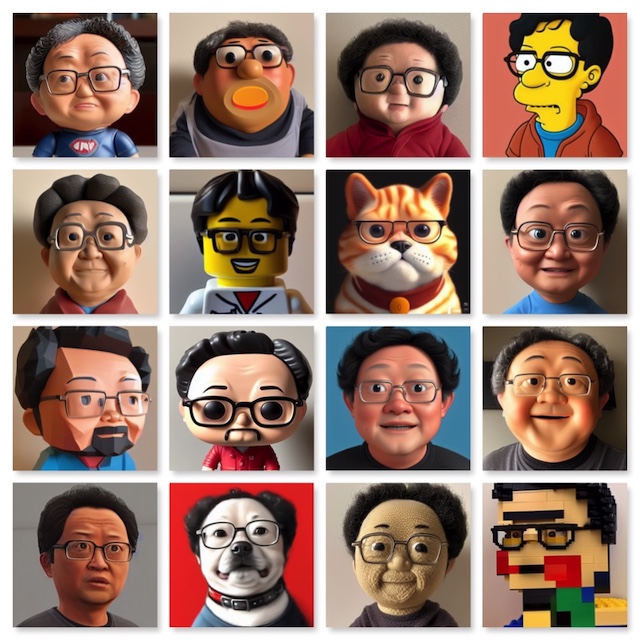
These AI-generated versions of me, rendered as toy figurines and crafted from different materials, came from training Stable Diffusion on my own photos. It’s a strange thing, seeing yourself reflected through a machine’s imagination. More on the process: Dreambooth Training for Personal Embedding.
The Blog: Mind Hack
This blog is my laboratory notebook. Since 2016, I’ve documented experiments in generative AI, deep learning, spatial reasoning, logic programming, blockchain, and the occasional philosophical tangent. It’s less a polished publication and more a record of genuine exploration: successes, dead ends, and everything between.
Browse the Research page for a map of where my curiosity has wandered.
Consulting & GameGrammar
Through Dynamind Research, I help organizations navigate AI strategy, software architecture, and technical problem-solving. Whether you’re building AI-powered products, need architectural guidance, or want to understand how generative AI fits your roadmap, I’d love to talk.
I’m also building GameGrammar, an AI-powered board game design tool where 6 specialized agents collaborate to create complete game designs in under 60 seconds. It’s my playground for exploring multi-agent systems, creative AI, and the intersection of structured reasoning with generative capabilities.
Let’s Connect
I love conversations about spatial cognition, the philosophy of machine intelligence, why Prolog deserves more respect, or anything at the intersection of creativity and computation.
For consulting inquiries: Visit dynamindresearch.com or contact me directly.
Drop me a line. I read everything.